
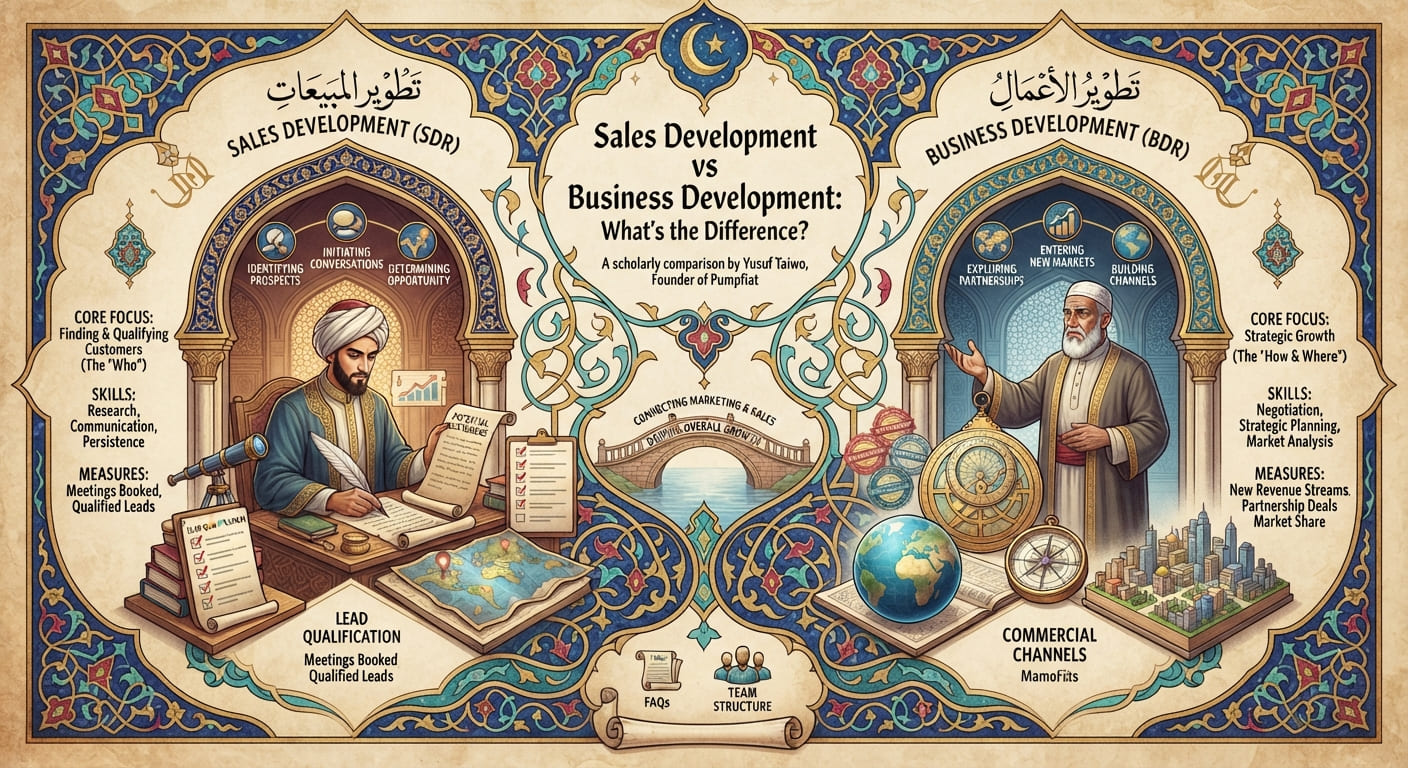
Sales development and business development both contribute to growth, and some companies use the terms interchangeably. In many organizations, however, sales development focuses on finding and qualifying potential customers, while business development can cover a broader set of opportunities such as partnerships, new markets, and commercial channels.
There is no universal definition for the titles SDR and BDR. When planning a team or evaluating a job, look at the actual responsibilities, decision rights, and expected outcomes—not the title alone.
1. What is sales development?
Sales development is the work of identifying potential customers, starting relevant conversations, and determining whether a sales opportunity should move forward. It often connects marketing activity with the sales professionals responsible for demonstrations, proposals, negotiation, or closing.
Common sales development responsibilities
- Research target companies and identify relevant decision-makers.
- Build and maintain accurate prospect records in a CRM.
- Contact prospects through approved channels with relevant, truthful messaging.
- Follow up appropriately, qualify interest, and schedule sales conversations.
- Keep records of interactions and hand off opportunities using agreed criteria.
An inbound SDR may respond to people who have expressed interest; an outbound SDR may proactively identify and contact potential customers. Some roles combine both. Define which sales motion applies, who owns each handoff, and what qualifies as an opportunity before hiring.
2. What is business development?
Business development is often a broader commercial function focused on creating growth opportunities. Depending on the company, the work may include identifying markets, building strategic relationships, developing partnerships, finding distribution channels, or pursuing new customer opportunities.
Common business development responsibilities
- Research new industries, regions, or customer segments.
- Identify and develop partnerships, referral sources, or distribution relationships.
- Build commercial relationships with customers, partners, or other organizations.
- Evaluate new channels and opportunities for revenue or market expansion.
- Coordinate internal teams and develop opportunities over a longer horizon.
In some businesses, a BDR performs standard outbound prospecting much like an SDR. In others, the title refers to strategic partnerships or market expansion. Read the job description closely.
3. Sales development vs business development: Key differences
| Dimension | Sales development | Business development |
|---|---|---|
| Typical focus | Create qualified sales opportunities | Develop broader growth opportunities |
| Common activities | Prospecting, qualification, meeting setting | Partnerships, markets, channels, commercial relationships |
| Typical audience | Potential customers and buying contacts | Customers, partners, distributors, and organizations |
| Possible output | Qualified conversations and opportunities | New relationships, markets, channels, or opportunities |
| Common title | SDR | BDR or Business Development Manager |
These are common patterns, not fixed rules. A smaller organization may assign several activities to one person, while a larger company may define distinct functions.
4. SDR vs BDR: Are they the same?
Sometimes. Some organizations use SDR and BDR interchangeably; others use SDR for inbound qualification and BDR for outbound prospecting, or apply the titles in the opposite way. Some use BDR for strategic relationship work. The acronyms alone do not tell you what someone will do.
When reviewing a role, clarify whether the person handles inbound leads, proactive prospecting, qualification, partnerships, market research, negotiation, or closing. Also ask how much of their time is expected for each area and how success will be assessed.
5. Skills for sales development and business development
Sales development skills
- Communication: explain the offer clearly and adapt to the prospect’s context.
- Research: understand target businesses and identify appropriate contacts.
- Personalization: connect the message to a verified reason for outreach.
- Qualification: establish whether there is a relevant need and appropriate next step.
- Organization and resilience: manage records and follow-ups professionally while learning from responses.
Business development skills
- Relationship building: develop trust with customers, partners, and stakeholders.
- Strategic thinking: identify opportunities that may support longer-term growth.
- Commercial judgment: assess the potential value, resource needs, and risks of an opportunity.
- Negotiation and influence: communicate shared value and align expectations.
- Market research: understand industries, competitors, and regional context.
Both roles need clear communication, reliable follow-through, and sound judgment. The emphasis depends on the work the organization actually assigns.
6. Measure each role against its real contribution
Use metrics that reflect responsibilities and quality. Avoid rewarding activity counts without considering relevance and outcome.
Possible sales development measures
- Target account and contact fit.
- Qualified conversations and meetings held.
- Meeting-to-opportunity conversion and accepted handoffs.
- Pipeline created and progression, with agreed attribution.
- Data quality, follow-up reliability, and compliance with process.
Possible business development measures
- Qualified partnership or market opportunities developed.
- Partner-sourced pipeline or revenue where reliably attributable.
- New distribution channels or commercial relationships that meet defined criteria.
- Strategic opportunities advanced against agreed milestones.
A signed partnership is not automatically valuable if it produces no meaningful business result. Similarly, an SDR should not be judged only by calls made. Make sure definitions, time horizons, and attribution are documented. See our SDR KPI guide for sales development metrics.
7. Where do these roles fit in a sales organization?
A simplified commercial organization may include marketing to build awareness and interest; sales development to identify and qualify opportunities; account executives to conduct sales conversations and close deals; and customer success or account management to support retention and expansion. Business development may work across functions to develop partnerships, new markets, and channels.
In a small business, one person may perform several of these responsibilities. As the company grows, separate ownership can improve focus and accountability—provided that handoffs and shared goals are clear.
8. Should you hire an SDR or a Business Development Manager?
Consider an SDR when
- You have a defined offer and target customer.
- You need more qualified sales conversations.
- Your sales team needs prospecting capacity and a repeatable qualification process.
Consider a Business Development Manager when
- You are exploring new markets or strategic partnerships.
- You need distribution relationships or new commercial channels.
- You need someone to develop broader growth opportunities over time.
Consider both when
- Your business can support specialized roles and distinct objectives.
- You need consistent prospecting alongside strategic growth initiatives.
Do not hire a senior partnership-focused manager if the actual need is routine prospecting, or expect an early-career SDR to negotiate complex strategic agreements without support. Define the job before choosing the title.
9. Can one person handle both roles?
Yes, particularly in startups and small businesses. A founder or early commercial hire might prospect, hold sales conversations, explore partnerships, and research new markets. This can be practical when resources are limited.
The trade-off is focus. If daily prospecting consumes most of the role, there may be little time for longer-term partnership development. Review workload and outcomes as the business grows; split the responsibilities when distinct workstreams need dedicated attention.
10. Build a clear sales development and business development team
- Define the commercial objectives: qualified sales conversations, new markets, partnerships, or channels.
- Write clear responsibilities and ownership boundaries for each role.
- Document how prospects and opportunities are identified, qualified, transferred, and managed.
- Choose performance measures that reflect each role’s contribution.
- Recruit for job-related skills and use practical, fair assessments.
- Set up feedback between marketing, SDRs, account executives, and business development.
Remote teams can recruit across locations, subject to language and time-zone needs, market knowledge, compensation expectations, and local employment requirements. Read our guides to hiring a remote SDR and remote sales hiring locations.
Frequently asked questions
What is the difference between sales development and business development?
Sales development commonly focuses on finding and qualifying potential customers for sales. Business development often includes broader growth activities such as partnerships, market entry, and commercial channels. Company definitions vary.
Is an SDR the same as a BDR?
Not always. Some companies use the titles interchangeably; others distinguish inbound qualification, outbound prospecting, or strategic development. Check the responsibilities.
Does business development involve sales?
It can. Business development may involve customer acquisition and commercial negotiation, as well as partnerships and market expansion.
Which role is more senior, SDR or BDR?
Neither title has a universal seniority level. Seniority depends on the organization’s job structure, responsibilities, and experience requirements.
Can business development representatives close deals?
Some do, while others develop opportunities for another team. The company should state who owns qualification, negotiation, and closing.
Should a startup hire an SDR or a business development manager?
A defined product and target market with a need for more sales conversations may call for an SDR. Strategic partnerships or market entry may call for business development. The actual bottleneck should guide the hire.

About the author
Yusuf Taiwo is the founder of Pumpfiat, a Notion Partner, automation expert, and AI systems builder. Read Yusuf’s profile and experience.
Give every commercial role a clear purpose
Explore Pumpfiat resources on hiring, prospecting, and sales development operations.