
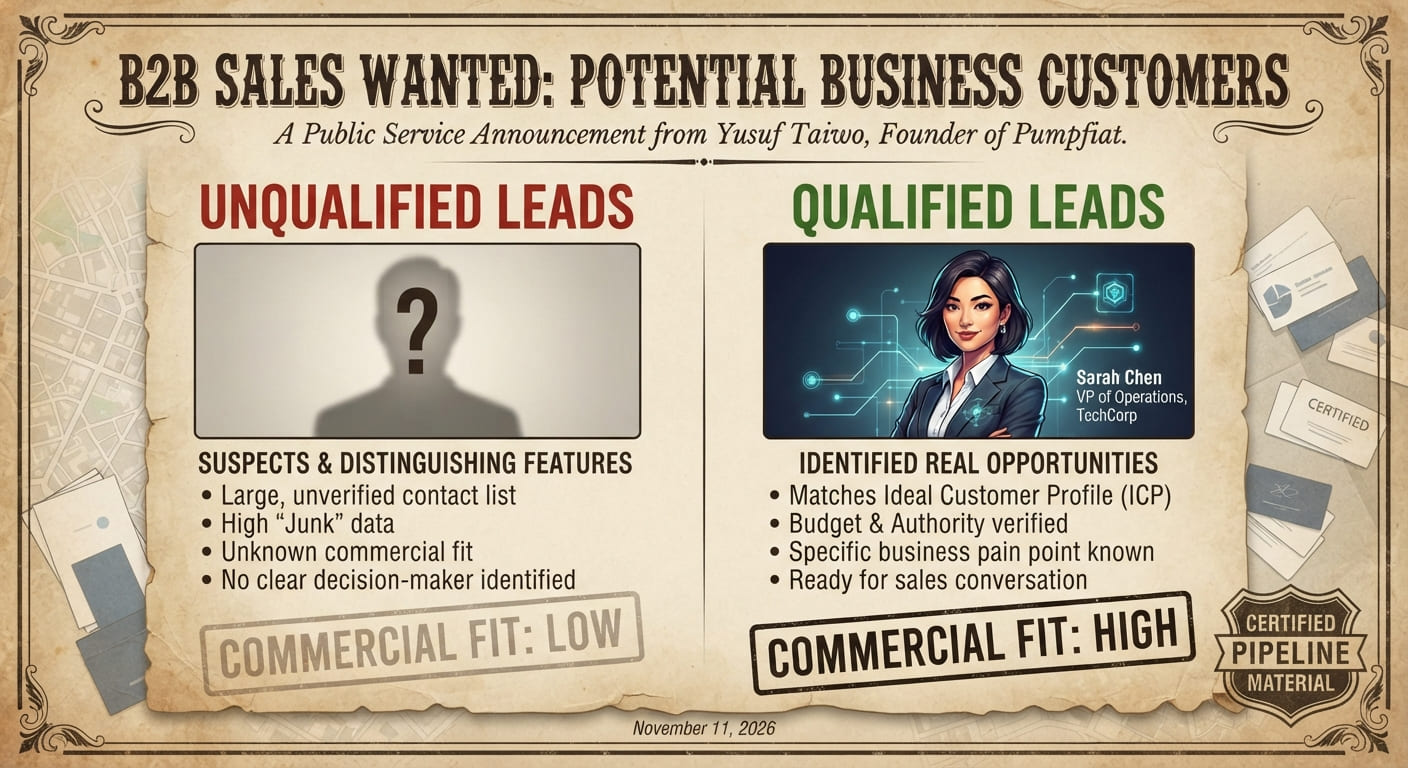
A strong product and capable sales team still need a reliable way to find the businesses that could benefit from what you offer. B2B lead generation is the process of identifying potential business customers, attracting their interest, and creating opportunities for a relevant sales conversation.
Search, useful content, professional networks, referrals, advertising, and direct prospecting can all contribute. But a large contact list is not the same as a pipeline of qualified business leads. The goal is to create a repeatable system that prioritizes commercial fit and gives sales enough context to follow up well.
1. What is B2B lead generation?
B2B means business-to-business: a company sells products or services to other organizations. Lead generation is the work of finding and attracting possible buyers, then capturing enough relevant information to determine an appropriate next step.
A lead might refer to a target company, a decision-maker at that company, or a buying conversation. Define the term within your organization so marketing, SDRs, and account executives use consistent criteria. A lead should not be treated as an opportunity or a customer until it meets the appropriate stage requirements.
2. Understand the difference between leads and qualified leads
Not every contact has a plausible need, fit, authority, or reason to buy. For example, an ecommerce development agency may collect a list of retailers, but some may not sell online and others may already have the capabilities they need. The list is a set of contacts; it is not automatically a list of qualified opportunities.
Qualification is the process of checking whether a potential customer matches defined commercial criteria. Depending on your offer, those criteria might include:
- Industry, company size, geography, or business model.
- A relevant need or business problem your product can address.
- Access to an appropriate decision-maker or influencer.
- Existing technology, budget context, or ability to implement a solution.
- Timing, expressed interest, and any reason the account is not a fit.
Use a consistent definition of a qualified lead and document why a prospect meets it. This helps the team improve handoffs and makes campaign results easier to interpret.
3. Define your Ideal Customer Profile
An Ideal Customer Profile (ICP) describes the type of organization most likely to benefit from your offer. It gives SDRs and marketers a practical filter for prioritizing accounts before they spend time researching and contacting them.
Consider industry, company size, geography, business model, relevant roles, operational context, and problems your product can genuinely solve. Use what you have learned from real customers and sales conversations; revisit the profile when evidence changes.
| Attribute | Illustrative example |
|---|---|
| Industry | Professional services |
| Company size | 10–100 employees |
| Geography | Markets the provider can serve |
| Decision-maker | Managing partner or marketing lead, depending on the offer |
| Possible need | A documented gap in online client acquisition |
| Offer | Website redesign and digital strategy |
This is an example, not a universal profile or a recommendation to assume a prospect has a problem. Validate the fit with research and conversation.
4. Choose B2B lead generation strategies that fit
There is no single best channel for every company. Choose based on where your buyers research, how they make decisions, your sales cycle, available resources, and whether you can measure the path from first contact to customer.
Search engine optimization and content marketing
Search-focused pages and useful resources can help a business reach people actively researching a problem. Publish content that answers real customer questions, demonstrates knowledge, and provides a sensible next step. Organic visibility usually requires consistent, technically sound work and should not be treated as an instant source of leads.
LinkedIn and professional networks
Professional platforms can help teams research accounts, understand roles, and participate in relevant discussions. Use context and authentic engagement rather than sending identical pitches to every connection.
Email and direct prospecting
Targeted outreach can introduce an offer to a relevant business when there is a clear reason for contact. Verify contact details, personalize based on accurate research, manage follow-ups, and apply the requirements relevant to the sender, recipient, data, and channel. Read our guide to cold email for B2B sales.
Referrals, partnerships, and events
Customers, professional relationships, channel partners, and industry events may introduce businesses with existing context. Track referral sources and make it easy for the receiving sales team to understand the introduction and agree on follow-up.
Paid advertising
Search and professional-network advertising may help reach people by intent or business attributes. Set a clear budget, landing-page goal, and lead-quality review process; do not judge campaigns by form submissions alone.
Local and industry research
Business directories, association listings, and map services can help find relevant companies in a defined market. Use them as research starting points, verify current details, and review the data terms and legal obligations that apply before contacting individuals.
5. Build a repeatable B2B lead generation process
- Set the objective: decide whether you need qualified conversations, opportunities, pipeline, or another measurable outcome.
- Agree on the ICP: identify target accounts and explicit disqualifiers.
- Select channels: choose acquisition methods that suit the buyer and available team capacity.
- Research and engage: capture the reason for contact and use a relevant, accurate message.
- Qualify and route: apply consistent criteria and make a clear handoff to the person responsible for the next stage.
- Record outcomes: update CRM records, follow-up tasks, opt-outs, and source information accurately.
- Review and improve: examine where prospects drop out and change one part of the process at a time.
A practical B2B pipeline may move from identified account, researched prospect, initial engagement, response, qualification, meeting, opportunity, proposal, and customer. Actual stages and ownership should reflect your sales model; not every lead will follow the same path.
6. Qualify leads using fit, need, authority, and timing
A simple qualification conversation can explore four areas:
- Fit: Does the organization match the ICP?
- Need: Is there a relevant problem the offer could address?
- Authority: Is the contact involved in the decision or able to connect you with the right person?
- Timing: Is there a realistic reason to discuss a solution now or later?
Teams may use a small scoring rubric to prioritize accounts, but scores are internal aids, not universal standards. Record the evidence behind a score and avoid treating inferred budget or urgency as fact.
7. Turn potential leads into customers
Lead generation does not end when someone submits a form or replies to an SDR. Respond within an agreed service window, understand the prospect’s requirements, confirm whether the offer fits, and route the conversation to the appropriate owner.
Sales, marketing, and customer teams should agree what information is needed at each handoff, what counts as an accepted opportunity, and how rejected or delayed leads are handled. Clear definitions prevent qualified prospects from getting lost and help the business learn from feedback.
8. Measure B2B lead generation performance
Use measures that connect acquisition activity to commercial results. Possible metrics include:
- Leads identified and percentage meeting ICP criteria.
- Qualified leads and lead-to-meeting conversion.
- Meetings booked, held, and accepted as qualified opportunities.
- Opportunity conversion, pipeline created, and customer conversion.
- Cost per qualified opportunity and customer acquisition cost, where attribution is reliable.
- Time to first response, follow-up completion, and source/channel contribution.
For example, a hypothetical campaign might identify 200 contacts, with 80 matching qualification criteria, 20 booking a meeting, 15 attending, five becoming qualified opportunities, and two becoming customers. These figures are illustrative only, not a benchmark. The pattern helps identify where to investigate; it does not explain the reason without reviewing data and conversations.
For SDR-level activity, conversion, and pipeline measures, see our guide to SDR KPIs and metrics.
9. Common B2B lead generation mistakes
- Targeting everyone: broad targeting makes relevance and learning harder.
- Buying lists without review: records may be inaccurate, irrelevant, or collected under terms that do not fit your use.
- Calling contacts opportunities: define qualification before reporting pipeline.
- Ignoring follow-up and suppression: maintain a clear process for replies, opt-outs, and objections.
- Measuring only volume: consider qualified outcomes and downstream conversion, not raw contacts alone.
- Skipping attribution: capture useful source information without pretending that every conversion has a single cause.
10. Generate leads internally or work with a partner?
An internal team can offer direct control over research, qualification, messaging, and customer relationships, but needs people, training, management, and tools. An external provider may add capacity or expertise, but requires clear standards for sourcing, data access, qualification, reporting, compliance, and ownership.
Some businesses use a hybrid model, with an external partner supporting research or approved campaign operations while internal sales handles conversations and closes opportunities. Compare the trade-offs in our guide to in-house SDRs versus outsourced sales development.
Frequently asked questions
What is the best way to generate B2B leads?
There is no single best method. SEO, content, professional networks, email, paid advertising, referrals, and direct prospecting may all work depending on the audience, offer, and sales process.
What is a qualified B2B lead?
It is a potential customer that meets your organization’s defined criteria for fit, need, access to a decision-maker, and buying potential.
How many B2B leads should a business generate?
Work backward from customer goals using your own conversion history and sales capacity. There is no universal lead count that guarantees revenue.
Is lead generation the same as sales prospecting?
They overlap. Lead generation is the broader activity of attracting and identifying potential buyers; prospecting often refers to researching and approaching specific accounts or contacts.
Can a small business generate B2B leads without advertising?
Yes. Referrals, useful content, organic search, professional relationships, partnerships, and focused direct prospecting are possible approaches.
How much does B2B lead generation cost?
Costs vary by channel, market, sales complexity, and internal resources. Consider the total cost per qualified opportunity or customer rather than only the cost of collecting a contact.

About the author
Yusuf Taiwo is the founder of Pumpfiat, a Notion Partner, automation expert, and AI systems builder. Read Yusuf’s profile and experience.
Build a repeatable lead generation process
Explore Pumpfiat resources on prospecting, SDR hiring, and sales development operations.