
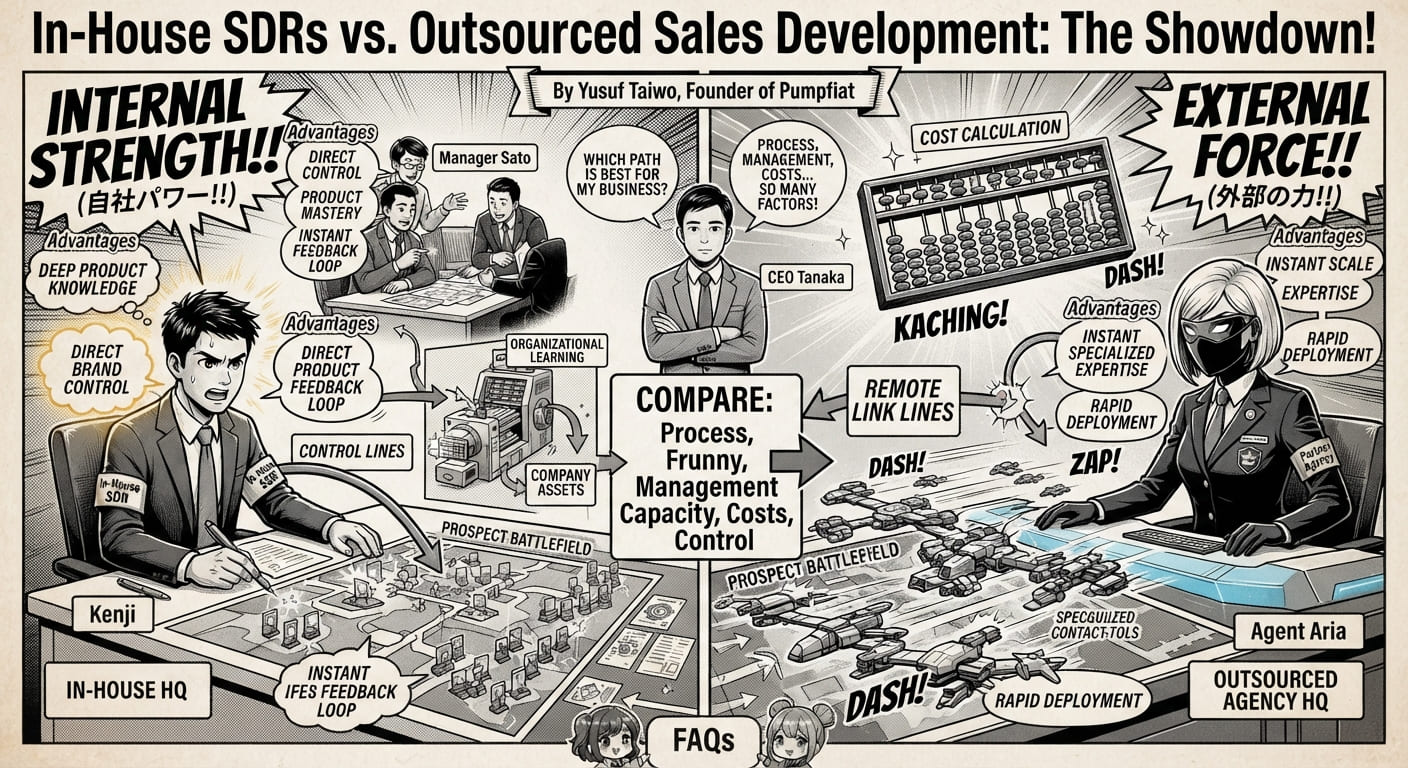
Your company needs a reliable way to find potential customers and develop qualified sales opportunities. Should you recruit and manage your own Sales Development Representatives (SDRs), or ask an external provider to run some or all of that work?
Both models can work, and neither is automatically cheaper, faster, or more effective. The right choice depends on the complexity of your offer, how repeatable your sales process is, the management capacity you have, and how much control you need over prospecting and customer conversations.
1. What is an in-house SDR team?
An in-house SDR team consists of representatives employed or directly engaged by your organization and managed by your sales leadership. Their work may include researching target companies, identifying decision-makers, preparing prospect lists, contacting prospects, qualifying interest, booking meetings, and keeping accurate CRM records.
Because internal SDRs work within your company, they can build a deeper understanding of the product, customer, brand, and sales strategy. They can also share market feedback directly with marketing, account executives, customer success, product, or technical teams.
Advantages of hiring SDRs internally
- Direct control: Your team owns targeting, messaging, qualification, coaching, and day-to-day priorities.
- Product knowledge: Representatives can learn complex use cases and improve through close work with internal experts.
- Organizational learning: Prospect insights, objections, and process improvements stay within the business.
- Customer relationship oversight: You have direct visibility into how your brand is represented and how prospects are treated.
Trade-offs to plan for
- Recruitment, interviewing, onboarding, training, coaching, and performance management take internal time.
- Budget for more than salary: employment costs, benefits, tools, data, equipment, training, and management may all matter.
- Scaling the team requires hiring capacity and suitable sales leadership; additional headcount alone does not ensure better outcomes.
2. What is outsourced sales development?
Outsourcing sales development means engaging an external company or specialist to perform part or all of the prospecting and early-stage sales process. Depending on the agreement, services may include research, list development, contact-data enrichment, email or phone outreach, professional-network prospecting, appointment setting, campaign operations, and reporting.
Providers vary. One may supply data only, another may operate campaigns, and another may assign dedicated SDR capacity. Before comparing price, clarify exactly which people, hours, channels, tools, and outputs are included.
Potential advantages
- Access to an established operating team, tools, and sales-development experience.
- Less direct responsibility for some recruiting, training, supervision, or campaign administration, depending on scope.
- Potentially flexible capacity for a time-limited campaign or market test.
- Access to specialized industry, regional, or channel knowledge when it is relevant and verifiable.
Risks and limitations
- Less direct day-to-day control over individual SDRs and execution quality.
- Representatives may have limited product knowledge or work across several clients unless the arrangement specifies otherwise.
- Provider dependency can make switching disruptive; document data access, campaign assets, and transition steps.
- Headline fees may exclude setup, data, software, management, extra channels, or additional representatives.
- Your business still needs oversight of customer experience, data handling, opt-outs, and applicable marketing obligations. Outsourcing does not automatically transfer every responsibility.
3. In-house SDRs vs outsourced sales development
| Area | In-house SDRs | Outsourced sales development |
|---|---|---|
| Management | Internal leaders manage and coach | Provider manages or supervises, as agreed |
| Recruiting | Your organization recruits directly | May be handled by the provider |
| Product expertise | Can deepen through internal collaboration | Requires structured onboarding and updates |
| Control | Direct ownership of daily execution | Depends on scope, access, and agreement |
| Costs | Employment plus tools, training, and management | Service fee plus any excluded costs |
| Long-term capability | Builds internal knowledge and process | May increase reliance on provider operations |
| Flexibility | Changes managed directly; hiring can take time | Capacity changes depend on contract and provider |
The real distinction is who owns the process, manages the people, controls prospect data, and is accountable for what happens after a meeting is booked. Spell out handoffs and responsibilities before choosing.
4. Compare total costs, not headline prices
There is no universal cost for either model. Internal costs vary with country, compensation, benefits, employment arrangement, tools, experience, and management. Outsourced fees vary with the provider, service scope, market, number of representatives, and commercial terms.
The following figures are a hypothetical illustration only, not current salary data, a market benchmark, or a Pumpfiat quote. Actual costs and what is included can differ substantially.
| Illustrative monthly item | One in-house SDR | Outsourced service |
|---|---|---|
| Salary / provider fee | $3,000 | $3,500 |
| Employment costs and benefits / data | $600 | $200 |
| Software / additional software | $300 | $100 |
| Equipment and management allocation | $600 | Confirm what the fee includes |
| Illustrative total | $4,500 | $3,800* |
*The provider example adds the stated fee, data, and software only. Any of those items may already be included in a real agreement; the example is not directly comparable without confirming scope, time dedicated, seniority, management, and output.
Compare total cost against qualified opportunities and downstream conversion, while accounting for the value of product learning and control. Cost per qualified opportunity can help frame the discussion, but only if both teams use the same qualification definition and reliable attribution.
For a deeper breakdown, read our SDR hiring cost guide.
5. Consider hiring remote SDRs directly
Outsourcing is not the only alternative to building an office-based team. You can hire remote SDRs directly, including in other countries, while keeping more management and process ownership inside your business.
Direct international hiring may broaden your talent pool, but it introduces country-specific considerations such as employment law, worker classification, payroll, tax, benefits, working hours, and data protection. An Employer of Record (EOR) may provide employment administration in some situations, but does not remove the need to understand your legal and operational obligations.
Review our guides to hiring SDRs globally, comparing remote sales hiring locations, and evaluating remote SDR candidates.
6. Questions to ask an outsourced SDR provider
Ask operational questions and request clear answers before signing. Make sure the agreement and the actual delivery model match.
People and management
- Who performs outreach, and are they dedicated to our account?
- What experience do the representatives have, and who trains, coaches, and supervises them?
- What happens if the assigned representative leaves or the work quality is not acceptable?
Prospecting, data, and compliance
- How are target companies selected and contact details sourced or checked?
- Can we approve the account list and review the qualification criteria?
- How are opt-outs and objections recorded, shared, and enforced?
- What privacy, security, and marketing practices apply to our campaign?
Reporting and commercial terms
- Which activity, conversion, and outcome metrics are reported, and how is a qualified meeting defined?
- Can we access the CRM and review conversation records where appropriate?
- What does the fee include—setup, software, data, management, channels, and dedicated hours?
- Who owns prospect records, CRM data, campaign content, and work product during and after the engagement?
- What are the contract term, termination conditions, and transition process?
7. A hybrid sales development model may fit
A hybrid team combines internal sales ownership with carefully scoped external capacity. For example, your internal team might own the ICP, messaging, qualification, strategic prospects, CRM rules, and closing conversations, while a partner supports approved research, list preparation, or outreach execution.
The hybrid model can preserve product knowledge and customer relationships while adding capacity. It also requires clear accountability: define who approves messages, who handles replies and opt-outs, how data moves between systems, how meetings are qualified, and who coaches the SDRs.
8. How to choose the right model
Consider an in-house team when
- Your product or sales conversation requires deep, evolving knowledge.
- You have a repeatable ICP, message, qualification process, and internal sales leadership.
- Sales development is a long-term capability you want to build and learn from directly.
- Your SDRs need close collaboration with account executives, marketing, or product teams.
Consider outsourcing when
- You want to test a specific market or campaign with a defined scope.
- You need additional capacity or specialist operating experience.
- Your organization lacks the recruitment or campaign operations capacity for a particular project.
- You can define success, provide sound onboarding, and actively oversee quality and data handling.
Consider a hybrid approach when
- Your internal team can own strategy and customer relationships but needs help with selected execution work.
- You want to expand capacity without immediately delegating the entire process.
- You can make handoffs, approvals, system access, and responsibilities explicit.
Before committing, write down the business outcome you need, the current bottleneck, the people and systems available, and what you will learn from a time-bounded test. Define quality metrics alongside activity, then review the results before scaling.
Frequently asked questions
Is outsourcing SDRs cheaper than hiring in-house?
It can be in some arrangements, but the answer depends on what each price includes and what outcomes are delivered. Compare complete costs, qualified opportunities, management requirements, and data ownership—not a provider’s fee against base salary alone.
Are outsourced SDRs effective?
They may be effective when the provider understands the target market, receives useful product training, uses appropriate prospecting methods, and works to agreed definitions of quality and outcomes. Review real execution and results rather than relying only on a sales presentation.
Should a startup outsource sales development?
Some startups use an external provider to test a market or add capacity; others hire directly to build product knowledge and control. The decision depends on how well the sales process is understood and what internal management resources are available.
Who owns leads generated by an outsourced SDR agency?
Set out access and ownership for prospect records, CRM data, outreach history, campaign assets, and work product in the agreement. Confirm how those materials are returned or deleted when the engagement ends.
Can I hire remote SDRs instead of outsourcing?
Yes. Direct remote hiring gives you a different balance of management and control, while cross-border employment and contractor arrangements have local legal and operational requirements.

About the author
Yusuf Taiwo is the founder of Pumpfiat, a Notion Partner, automation expert, and AI systems builder. Read Yusuf’s profile and experience.
Build a sales development model that fits
Explore Pumpfiat resources on hiring, outbound operations, and SDR performance.