
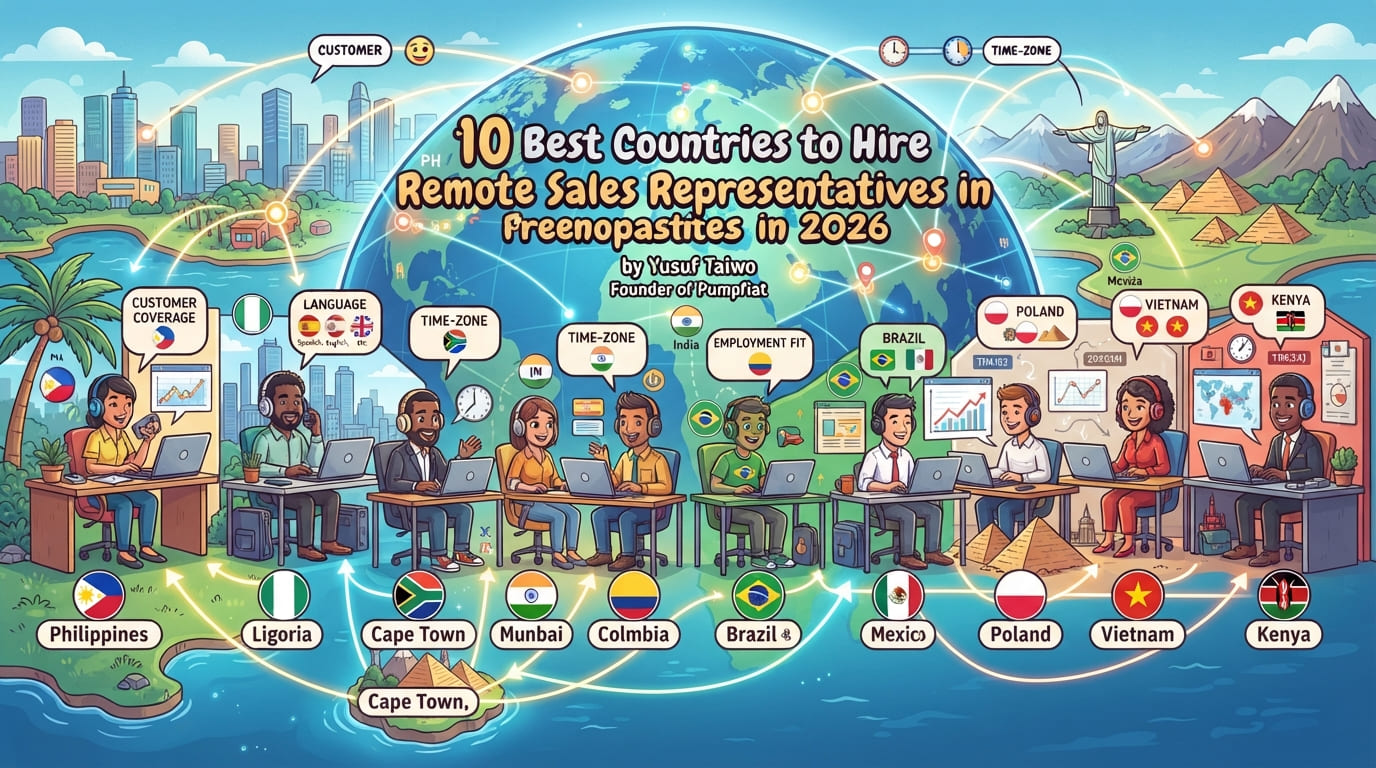
Hiring sales representatives is no longer restricted to finding candidates in the same city or country as your business. Companies can recruit remote sales development representatives (SDRs), build distributed teams, and reach customers across regions.
Where should you start: the Philippines, Nigeria, South Africa, India, Colombia, or somewhere else? The answer depends on what you sell, who your customers are, the languages the role needs, the working hours, and your employment setup. This guide compares ten markets to help you plan global sales recruitment without treating a person's location as a substitute for assessing their skills. Businesses looking to hire international sales representatives or offshore sales representatives should use the same role-related standards wherever they recruit.
Why hire sales representatives internationally?
Access a wider talent pool
Recruiting internationally can introduce candidates with different language skills, customer-facing experience, and industry backgrounds. It can help a growing company widen its search beyond the area around its headquarters. If you plan to hire remote SDRs, start by defining the customer, territory, and outcomes the role owns.
Reach customers in more markets
A representative who speaks a buyer's language and understands the market may help your team communicate with prospects more effectively. For example, a company expanding into Germany may need German-language sales capability; a company targeting Latin America may need Spanish or Portuguese.
Plan coverage across time zones
A distributed team can cover more customer hours, provided schedules, handoffs, coaching, and reporting are planned. Remote hiring does not remove the need for active management.
Allocate the full hiring budget flexibly
Compensation expectations and employment costs differ by market. Treat location as one budgeting factor—not a reason to compromise on fair pay, clear terms, or candidate quality.
10 countries to consider when hiring remote sales representatives
There is no universally best country for SDRs or business development representatives (BDRs). These are markets to investigate, not rankings of candidate quality. Validate role-specific demand and compare individual candidates.
1. Philippines
The Philippines has an established international remote-work and business-services ecosystem. Employers may find candidates with experience in customer support, appointment setting, or outbound communication. Assess each person's sales skills, spoken and written English for the actual role, product knowledge, and schedule fit.
2. South Africa
South Africa is worth exploring for English-language roles and teams serving the UK or parts of Europe, where working-hour overlap may be useful. Candidate experience, language capability, and customer-market familiarity should still be evaluated individually.
3. Nigeria
Nigeria offers a large and diverse professional talent pool, including people with experience in customer service, lead generation, marketing, and business development. Assess communication, technical readiness, relevant experience, and availability rather than assuming anything from location.
4. India
India has a large professional workforce and established business-services sector. It may be a useful place to search for sales talent with experience in technology, SaaS, outsourcing, or international customer operations.
5. Colombia
Colombia may suit companies reaching Latin American customers or seeking Spanish-speaking and bilingual candidates. Consider the specific language level required, territory, and overlap with North American business hours.
6. Argentina
Argentina is another market to explore for Spanish-language sales and internationally oriented professionals. Clarify compensation currency, payment practices, and local employment requirements before making an offer.
7. Poland
Poland may be relevant for companies selling across Europe and looking for European time-zone coverage. Some candidates may bring multilingual or international business experience; test for the language and market knowledge your territory actually requires.
8. Romania
Romania is worth considering for European customer coverage and candidates with experience in technology, business services, or international operations. Verify language proficiency and role-specific sales ability rather than relying on broad market assumptions.
9. Mexico
Mexico may be a fit for businesses targeting the United States or Latin America, including roles where Spanish and North American working-hour overlap matter. Evaluate bilingual communication and customer knowledge for the specific position.
10. Kenya
Kenya is an English-speaking market with a growing digital economy. Companies may find candidates with experience in technology, customer operations, and business development. Assess each candidate on the same role-related criteria you use elsewhere.
Quick comparison: which country should you choose?
Use this table as a starting point for research, not as evidence that every candidate in a country has the same skills or experience.
| Market | Potential reason to explore | Possible role fit |
|---|---|---|
| Philippines | International customer operations | English-language coverage for UK, US, or Australian markets |
| South Africa | English-language capability and European time overlap | UK and European customers |
| Nigeria | Broad professional talent pool | English-speaking international markets |
| India | Technology and business-services experience | SaaS and B2B technology |
| Colombia | Spanish-speaking and bilingual candidates | Latin America and North America |
| Argentina | Spanish-language talent | Latin American markets |
| Poland | European and multilingual talent | European markets |
| Romania | European business-services experience | European markets |
| Mexico | Spanish-language capability and US time overlap | US and Latin America |
| Kenya | English-language and digital-workforce access | International English-speaking markets |
The important question is not which country has the cheapest workers. It is which market gives you access to people who can effectively engage your intended customers, within a compliant and sustainable employment arrangement.
How to choose the right country for your sales team
- Start with your target customer. Identify the territory, buyer roles, language, and working hours involved.
- Specify the language level. Being conversational is different from being able to explain a product, ask discovery questions, and handle objections professionally.
- Decide how much time-zone overlap is needed. State whether the role is fully aligned with customer hours or can work asynchronously.
- Match experience to product complexity. An enterprise software sale may require different industry knowledge from a simple service sold to small businesses.
- Check employment and payment requirements. Review local rules for worker classification, tax, compensation, benefits, and payment. Get qualified local advice where needed.
How to find and evaluate remote SDRs internationally
Build a candidate pipeline across appropriate channels: LinkedIn, reputable remote job boards, recruitment partners, professional referrals, and relevant Reddit communities where recruiting is permitted. Follow each platform's rules and clearly state location eligibility, working hours, responsibilities, compensation, and training.
Use a structured, job-related process for every candidate. A person's country, accent, or previous job title should not determine whether they can succeed in the role.
- Give candidates a fictional customer to research and ask them to identify a likely decision-maker.
- Ask for a short sample prospecting email using the same prompt for each candidate.
- Run a simulated sales conversation relevant to the position.
- Ask how they organize prospecting and learn from rejection or coaching.
- For experienced candidates, discuss verifiable examples such as qualified meetings, pipeline, conversions, and quota attainment.
Keep assessments proportionate and avoid asking candidates to produce usable prospecting work for your real business as an unpaid test. Review EEOC guidance on employment tests and selection procedures for U.S. context; rules differ across jurisdictions.
For a step-by-step hiring process, read our guide on how to hire sales development representatives globally. Searches for the best countries for remote sales jobs can help identify markets, but the right choice still depends on the specific territory and role.
What Reddit discussions can add to your research
Recruitment discussions in sales and local employment communities can offer useful, first-person context on role expectations, hiring practices, schedules, and compensation. They are anecdotal—not representative evidence about a country's workforce—and should not replace candidate evaluation or local legal advice.
- Search r/philippinesjobs for remote sales representative discussions.
- Search r/JobPH for remote SDR discussions.
- Search r/sales for SDR hiring conversations.
- Search r/salesdevelopment for remote SDR conversations.
When reviewing a thread, check its date and context, distinguish an individual's experience from a general trend, and verify any factual or legal claim independently.
Frequently asked questions
Which country is cheapest for hiring remote sales representatives?
There is no single cheapest market for every role. Pay depends on experience, industry, language, working hours, and the legal employment arrangement. Compare total cost—not advertised salary alone.
Can I hire a remote SDR from Nigeria?
Companies can explore Nigerian candidates for international sales development roles, subject to appropriate local working arrangements and an assessment against the role's requirements.
Is the Philippines a good place to hire sales representatives?
It may be worth exploring given the international customer-service and business-services ecosystem. Evaluate candidates individually for sales ability, language needs, product knowledge, and schedule fit.
Can a remote representative work US business hours from another country?
Yes, but make the schedule clear during recruitment and account for local working-time requirements and the candidate's compensation expectations.
Should I hire an experienced SDR or train someone?
That depends on sales complexity, management capacity, and budget. Experienced SDRs may need less initial training; entry-level hires can work when you have structured onboarding and coaching.
How do I manage a sales team in several countries?
Use a CRM, documented processes, regular coaching, consistent performance reviews, clear communication channels, and measurable objectives.
Sources and further reading
About the author
Yusuf Taiwo is the founder of Pumpfiat, a Notion Partner, automation expert, and AI systems builder. Read Yusuf's full profile and experience.
Build a thoughtful global hiring plan
Explore Pumpfiat's resources on global SDR hiring and outreach.