
You hire an SDR, give them access to a CRM, prospecting tools, email, and sales materials. After a few weeks, they report hundreds of emails and calls—but you still do not know whether the business is getting closer to revenue. That's where SDR KPIs can help.
Sales development metrics help teams understand whether activity is creating meaningful commercial results and where coaching or process improvements are needed. For remote sales team management, a sound measurement system can support shared visibility without relying on physical presence or constant monitoring.
1. What are SDR KPIs?
SDR key performance indicators are measures selected to evaluate sales development effectiveness. These SDR metrics help answer how many prospects are contacted, how often they respond, how many conversations and meetings are qualified, how much opportunity pipeline is created, and how that pipeline progresses.
A high email count does not prove success if the list is poorly targeted. A high booked-meeting count does not prove success if prospects do not attend or meet qualification criteria. The purpose is to understand how activity connects to outcomes.
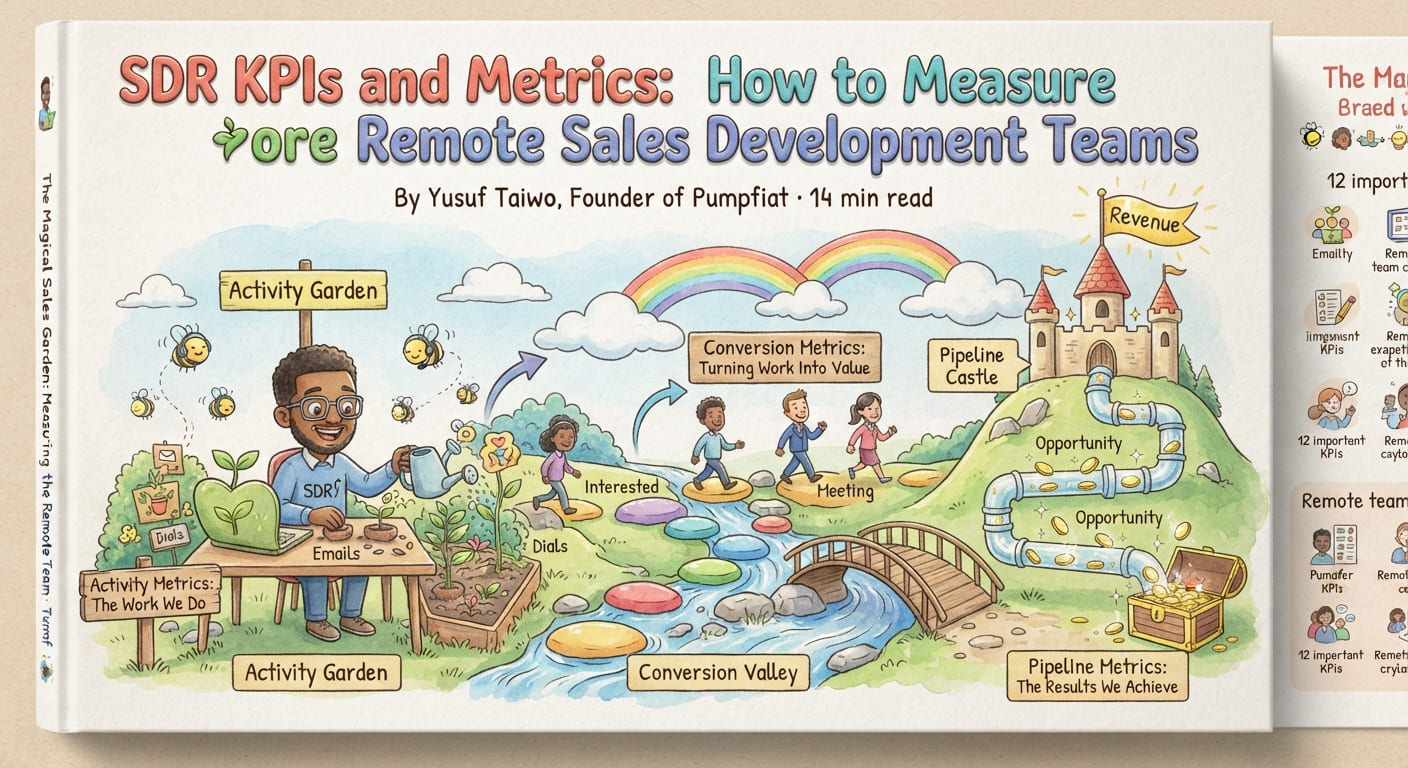
2. Three categories of sales development metrics
Activity metrics
Measure work performed: calls attempted, emails delivered, professional social touches, accounts researched, and follow-ups completed. They help managers understand consistency and workload, but do not establish commercial value by themselves.
Conversion metrics
Measure how activities become interactions: connection rate, reply rate, positive reply rate, conversation-to-meeting conversion, and meeting show rate. They help identify issues with targeting, message relevance, timing, or sales conversations.
Outcome metrics
Measure results that matter to the business: qualified meetings held, sales-accepted opportunities, pipeline generated, cost per qualified meeting, and revenue attributed to SDR-sourced opportunities.
A useful dashboard includes examples from all three categories so activity is interpreted in context.
3. Twelve important SDR performance metrics
1. Total outreach activity
What it measures: Prospecting activities completed over a defined period.
Formula: Calls + emails + professional social touches + other approved prospecting activities.
Example: 40 calls + 35 emails + 15 social messages = 90 touches. Use the count to understand workload and consistency, not as a standalone quality score.
2. Call connection rate
What it measures: Attempts that reach a live person.
Formula: (Live connections ÷ calls attempted) × 100. If 12 of 200 calls connect, the connection rate is 6%. Contact data, call timing, and audience can all affect this measure.
3. Email reply rate
What it measures: Delivered outreach emails receiving a response.
Formula: (Replies ÷ delivered emails) × 100. If 19 of 475 delivered emails receive replies, the reply rate is 4%. Separate positive responses, negative responses, automatic replies, and unsubscribe requests. Monitor bounce rates and deliverability too.
4. Positive reply rate
What it measures: Delivered emails receiving a commercially relevant response.
Formula: (Positive replies ÷ delivered emails) × 100. Define positive consistently—for example, an expression of interest, a meeting request, or a referral to the right buyer. Do not count automatic responses.
5. Qualified conversations
What it measures: Meaningful exchanges with prospects who fit the target profile. Define qualification—for instance, company fit, relevant role, plausible need, and willingness to consider a conversation. A reply or answered call alone is not necessarily qualified.
6. Meetings booked
What it measures: Sales meetings scheduled by the SDR. This is a production measure, not a quality outcome by itself. Agree in advance what makes a meeting relevant.
7. Meeting show rate
What it measures: Booked meetings that actually take place.
Formula: (Meetings held ÷ meetings booked) × 100. If 16 of 20 booked meetings are held, the show rate is 80%. Qualification, scheduling, expectation-setting, and reminders can affect it.
8. Sales-accepted meeting rate
What it measures: Held meetings accepted by the account executive against shared criteria.
Formula: (Sales-accepted meetings ÷ meetings held) × 100. Agree on acceptance rules; inconsistent feedback can distort the number.
9. Meeting-to-opportunity conversion
What it measures: Held meetings that become qualified opportunities.
Formula: (Qualified opportunities created ÷ meetings held) × 100. Interpret this with context: product, price, sales process, account executive follow-up, and market conditions may all affect conversion.
10. Pipeline generated
What it measures: Value of qualified opportunities attributed to the SDR's work. Count only opportunities that meet agreed CRM rules, and distinguish sourced pipeline from influenced pipeline.
11. Cost per qualified meeting
What it measures: Cost to produce a qualified meeting.
Formula: Total SDR costs ÷ qualified meetings held. State whether the calculation includes compensation, tools, recruitment, employment costs, and allocated management.
12. Quota attainment
What it measures: Progress against an assigned target.
Formula: (Actual performance ÷ assigned quota) × 100. If an SDR has a target of 10 held meetings and generates eight, attainment is 80%. Quotas should be realistic and based on the actual sales process.
4. What are good SDR benchmarks?
Benchmarks can provide context, but they are not universal targets. Results vary by industry, territory, deal size, sales cycle, inbound versus outbound motion, channels, product complexity, brand recognition, and market.
The Bridge Group's 2025 SDR Models, Motions & Metrics research is based on responses from 351 B2B companies. The study reports a median quota of 10 held meetings per month and says 60% of SDRs reached quota. Those figures are useful context, not universal targets; the study's North American B2B and SaaS weighting means teams in other markets or sales models should interpret them carefully.
Use external sales development representative benchmarks to ask better questions, then build your own targets from territory capacity, historical conversion, opportunity quality, and the team's sales model. Do not turn another company's median into a quota without checking whether the underlying work is comparable.
5. How to build an SDR performance dashboard
Start with a small, well-defined set of measures and a common reporting source. The sample below is illustrative—not an industry benchmark.
| Metric | Illustrative weekly result | Illustrative monthly result |
|---|---|---|
| Calls attempted | 200 | 800 |
| Emails delivered | 250 | 1,000 |
| Positive replies | 5 | 20 |
| Qualified conversations | 15 | 60 |
| Meetings booked / held | 5 / 4 | 20 / 16 |
| Sales-accepted meetings | 3 | 12 |
| Opportunities created | 1 | 4 |
| Pipeline generated | $10,000 | $40,000 |
Where useful, segment by SDR, campaign, industry, customer type, geography, outreach channel, and lead source. Keep definitions and attribution rules consistent.
6. How often should you review SDR performance?
Daily: operational organization
Review due follow-ups, responses needing attention, CRM accuracy, and blockers. The purpose is to support work—not create unnecessary surveillance.
Weekly: conversion and coaching
Review reply and connection rates, qualified conversations, meetings, show rates, common objections, and a sample of messages or calls. Identify one or two practical improvements.
Monthly: commercial outcomes
Review qualified and accepted meetings, opportunities, pipeline, quota attainment, and cost per qualified meeting.
Quarterly: strategy
Review market performance, sales capacity, recruitment needs, compensation, and changes to the ideal customer profile.
7. Use metrics to diagnose performance issues
High activity, low response
Possible causes include weak targeting, generic messaging, poor contact data, or sender reputation problems. Review the list and message quality before increasing volume.
Good response, few meetings
Review the call to action, qualification conversation, value proposition, and follow-up.
Many meetings booked, low show rate
Check qualification, meeting expectations, scheduling, and confirmation.
Meetings held, few opportunities
Review target customer fit, qualification, SDR-to-account-executive handoff, product fit, and pricing. Do not assume the SDR is the only cause.
Use the numbers to investigate and support—not to assign blame without evidence. Agree how rejected meetings are documented and who owns follow-up at each stage.
8. Manage performance across different countries
Remote SDRs may work different schedules, markets, and local employment arrangements. Set expectations around the customer market and the employee's agreed working hours. Do not penalize someone for missing a prospecting window they were not expected to cover.
- Use shared definitions for meetings booked, held, and accepted.
- Set targets in light of territory, deal size, product, and conversion history.
- Compare quality and commercial outcomes—not activity counts alone.
- Use regular coaching and clear records rather than constant monitoring.
9. Common mistakes when measuring SDRs
- Measuring only calls and emails rather than conversions and outcomes.
- Rewarding meetings regardless of relevance or qualification.
- Changing targets constantly without explaining the reason.
- Ignoring account executive feedback and handoff quality.
- Comparing different markets and sales motions without context.
- Collecting data without using it to coach or improve the process.
10. Improve SDR performance over time
Start with the weakest conversion point. If connection is low, inspect contact data and call timing. If replies do not become meetings, review messaging and conversations. If meetings do not create opportunities, examine qualification and the SDR-to-sales handoff.
- Measure current performance.
- Find the weakest conversion point.
- Investigate likely causes with the people doing the work.
- Make one targeted improvement.
- Review the result and repeat.
Frequently asked questions
What is the most important KPI for an SDR?
There is no single metric for every company. Qualified meetings held, sales-accepted opportunities, and pipeline are useful outcomes; activity and conversion explain how they are produced.
How many meetings should an SDR book per month?
It depends on market, product, deal size, and sales process. The Bridge Group's 2025 study of 351 B2B companies reported a median quota of 10 held meetings per month, but that is a reference point—not a universal target. Build your quota from your own conversion and capacity data.
Should SDRs be measured by calls or emails?
Track them where relevant, alongside reply rates, meaningful conversations, qualified meetings, and pipeline contribution.
What is the difference between an SDR KPI and an SDR metric?
A metric is a measurement. A KPI is a metric selected as especially important to performance or business goals.
How do you measure a remote SDR?
Use shared CRM definitions and reporting to track activity, conversion, meetings, opportunities, and pipeline; pair the data with regular coaching.
Can you measure SDR performance without a CRM?
A spreadsheet may work for a very small starting pipeline, but a CRM helps maintain accurate records and consistent reporting as activity grows.
Benchmark source
Bertuzzi, M. (2025). SDR Models, Motions & Metrics: 2025 Research Report (10th ed.), The Bridge Group. Read the research summary and methodology.

About the author
Yusuf Taiwo is the founder of Pumpfiat, a Notion Partner, automation expert, and AI systems builder. Read Yusuf's full profile and experience.
Make performance reviews more useful
Explore Pumpfiat resources on building and supporting global sales teams.