
Hiring a remote Sales Development Representative (SDR) can give your business access to a much larger talent pool. But having more candidates to choose from does not automatically mean finding the right salesperson.
A candidate may interview confidently without being good at prospecting. Someone with less formal sales experience may show strong research skills, curiosity, persistence, and clear communication. The challenge is to distinguish evidence of job-related ability from polish alone. This guide explains how to hire a remote SDR, what to evaluate, which interview questions to ask, and how to use practical, fair assessments.
1. Understand what your remote SDR will actually do
Before advertising the role, write down its responsibilities and expected outcomes. SDR work may include:
- Researching potential customers and identifying decision-makers.
- Building prospect lists and personalizing outreach.
- Contacting prospects by approved email, phone, or professional social channels.
- Following up, qualifying interest, and scheduling meetings.
- Updating the CRM with accurate activity and conversation records.
An inbound SDR responds to people who have expressed interest; an outbound SDR proactively finds and contacts prospective customers. A small business may need a hybrid role. Define which motion applies, who owns each handoff, and what qualifies as a good meeting before defining the candidate profile.
2. Define the skills and evidence you need
Communication
Can the candidate explain a product clearly, write a professional message, and hold a natural conversation with the buyer for this role?
Research and prospecting
Can they identify an appropriate company, relevant contact, and credible reason to reach out?
Personalization
Can they connect an offer to a prospect's context without relying on generic templates or unsupported claims?
Resilience and judgment
Can they handle rejection professionally, learn from unsuccessful attempts, and maintain consistent effort without resorting to irrelevant or excessive outreach?
Organization
Can they manage multiple prospects and follow-ups, maintain accurate records, and prioritize tasks reliably?
Coachability
Can they receive feedback, apply it, and improve? Use a short feedback exercise during the process rather than relying only on a candidate saying they are coachable.
Separate essential skills from skills that can be taught. Formal SDR experience can be useful but should not automatically outweigh transferable experience in customer support, recruitment, account management, fundraising, or business development. A clear remote SDR hiring scorecard helps your team focus on relevant sales development representative skills rather than assumptions about location or pedigree.
3. Where to find remote SDR candidates
- LinkedIn: search for experienced sales professionals by role, industry, and location.
- Remote job boards: reach candidates actively looking for distributed roles.
- Regional job boards: use market-specific platforms when you know where you can hire.
- Freelance platforms: consider only when the engagement and worker classification are appropriate.
- Referrals and sales communities: ask trusted contacts and participate in relevant communities while following their recruiting rules. For community perspectives, browse r/sales remote SDR discussions and r/salesdevelopment interview discussions; these are anecdotal, not hiring evidence.
Make the post transparent about location eligibility, schedule, compensation, responsibilities, targets, training, and employment arrangement. Do not select candidates just because of location or the lowest salary expectation. Compare evidence of their ability to do the job and make it clear that you hire remote sales representatives based on role-related skills.
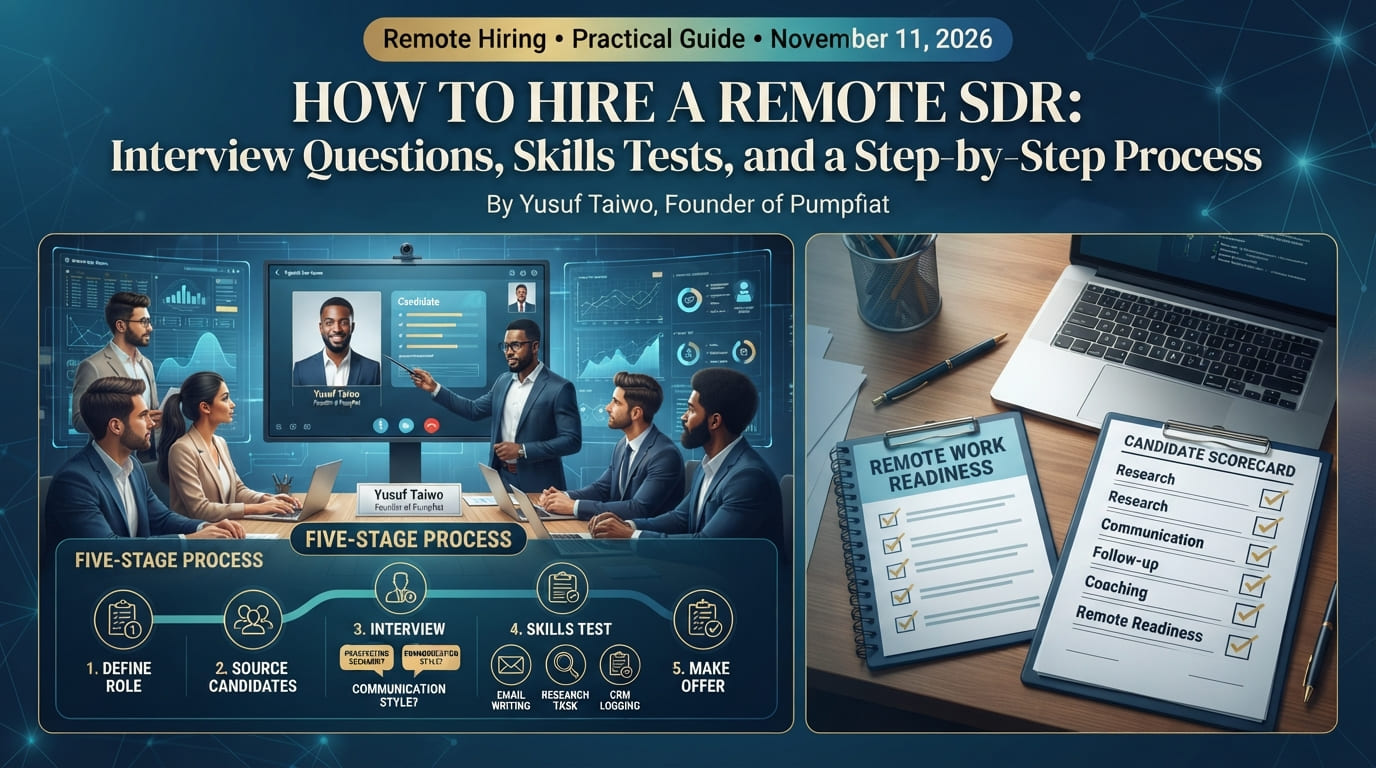
4. A five-stage remote SDR hiring process
Stage 1: Application screening
Review applications for role-related evidence: communication, customer-facing work, CRM familiarity, prospecting, independent work, language skills required for the role, and schedule availability. Use the same criteria for all candidates.
Stage 2: Initial interview
Ask consistent core questions, then use relevant follow-ups. Good SDR interview questions include:
- Why are you interested in sales development, and what do you understand about the role?
- How would you research a company before contacting it?
- Tell me about a time you handled rejection or an unsuccessful outcome.
- How do you organize work when managing several priorities and follow-ups?
- What would you investigate if your outreach received very few responses?
- How have you applied critical feedback to improve your work?
Listen to how candidates reason, not just whether an answer sounds polished. Keep questions job-related, accessible, and consistent.
Stage 3: Practical sales assessment
Use a short, fictional scenario that resembles the work without generating usable commercial output for your business. For example, give every candidate the same invented B2B company and ask them to identify a plausible customer, explain their research, draft one personalized message, and describe how they would track the follow-up.
Score research relevance, reasoning, writing clarity, attention to instructions, and how they explain their choices. This short SDR assessment test should be time-bounded and use the same brief for each person. Avoid unpaid assignments that produce usable prospect lists or campaign content.
Stage 4: Role-play
Give the candidate a short product description and a realistic prospect scenario. Ask them to open a discovery conversation. Use a standard objection such as “We already have a provider” or “Send me some information.” Look for active listening, relevant questions, a natural response, and good judgment—not arguing at all costs.
Stage 5: Final interview and references
Clarify compensation and commission, working hours, reporting, performance expectations, tools, equipment, training, and the proposed employment arrangement. Where appropriate and lawful, verify prior employment and speak with professional references.
For general U.S. guidance on candidate assessments, see the EEOC's page on employment tests and selection procedures. Hiring laws differ across countries; get local advice.
5. Use a practical remote SDR evaluation scorecard
Score candidates against the same criteria using a 1–5 scale. The weights below are a starting example; adjust them to the work and keep the total at 100%.
| Skill | Example weight | Evidence to consider |
|---|---|---|
| Communication | 20% | Clear, audience-appropriate writing and speaking |
| Prospect research | 20% | Relevant company and contact reasoning |
| Personalization and writing | 20% | Specific, accurate, concise message |
| Sales conversation | 15% | Listening, questions, judgment, response to objections |
| Organization | 10% | Reliable follow-up plan and accurate details |
| Coachability | 15% | Uses feedback to improve a second attempt |
| Total | 100% | Use as a discussion aid, not an automatic decision |
For each rating, record a brief example of evidence. A weighted score can support a structured discussion, but should not replace human judgment or a review of accessibility and fairness.
6. Assess readiness for remote work
Remote sales involves more than having a stable internet connection. Explore how the candidate plans work, reports progress, handles follow-ups, asks for help, communicates problems, and collaborates across time zones.
A useful scenario: ask how they would track a pipeline of 100 fictional prospects, record conversations, schedule follow-ups, and make sure interested people are not forgotten. Look for a repeatable system rather than reliance on memory or constant supervision.
7. Common remote SDR hiring mistakes
- Hiring on confidence alone: test research, writing, listening, and follow-through.
- Rewarding activity over quality: high volume with poor targeting can harm reputation and results.
- Ignoring the sales process: define the ideal customer, offer, messaging, and qualification criteria first.
- Expecting immediate results: provide product knowledge, practice, and feedback before judging performance.
- Leaving compensation unclear: explain salary, commission, targets, and payment conditions.
- Failing to define success: agree with sales on what counts as a qualified meeting.
8. What should happen after hiring?
Prepare the onboarding plan before the start date. A sample first month might look like this:
- Week 1—product and market: learn the offer, ideal customer, competitors, CRM, tools, and approved outreach practices.
- Week 2—prospecting and messaging: practice research, sample lists, outreach, qualification, and objection handling.
- Week 3—supervised outreach: begin approved outreach and review messages and calls with regular feedback.
- Week 4—calibration: review activity, conversation quality, meetings held, training needs, and realistic next targets.
Ramp time depends on the product, market, sales cycle, and candidate's experience. Build a coaching loop and measure both quality and outcomes. See our guide to SDR KPIs and performance metrics.
9. Hire directly or use a recruitment partner?
Hiring independently gives you control over sourcing, selection, compensation, and onboarding, but requires internal time to screen and interview. An external recruitment partner may help source candidates and coordinate parts of the process. Ask exactly what the service includes—sourcing, screening, skills assessments, interviews, references, international support, and any replacement policy—and compare the complete cost and quality.
Frequently asked questions
How long does it take to hire a remote SDR?
Timing depends on role requirements, sourcing channels, and interview steps. Use a focused process, but leave enough time to assess candidates fairly.
Do remote SDRs need previous sales experience?
Not always. Candidates from customer support, recruitment, business development, or other communication-heavy work may have transferable skills. Practical, role-related assessments can help evaluate potential.
What tools should a remote SDR know?
Common tools include a CRM, email and calendar software, prospect research tools, and team communication platforms. You can train candidates on your chosen tools.
Should I pay remote SDRs commission?
Many plans combine base pay with variable compensation. Define the outcomes, calculation, eligibility, and payment timing clearly, and check local rules.
How do I know if an SDR is good?
Evaluate prospect relevance, conversations, qualified meetings held, conversion into opportunities, and pipeline contribution—not email volume or calls alone.

About the author
Yusuf Taiwo is the founder of Pumpfiat, a Notion Partner, automation expert, and AI systems builder. Read Yusuf's full profile and experience.
Build a stronger global sales process
Explore Pumpfiat's resources on international hiring and sales development.