
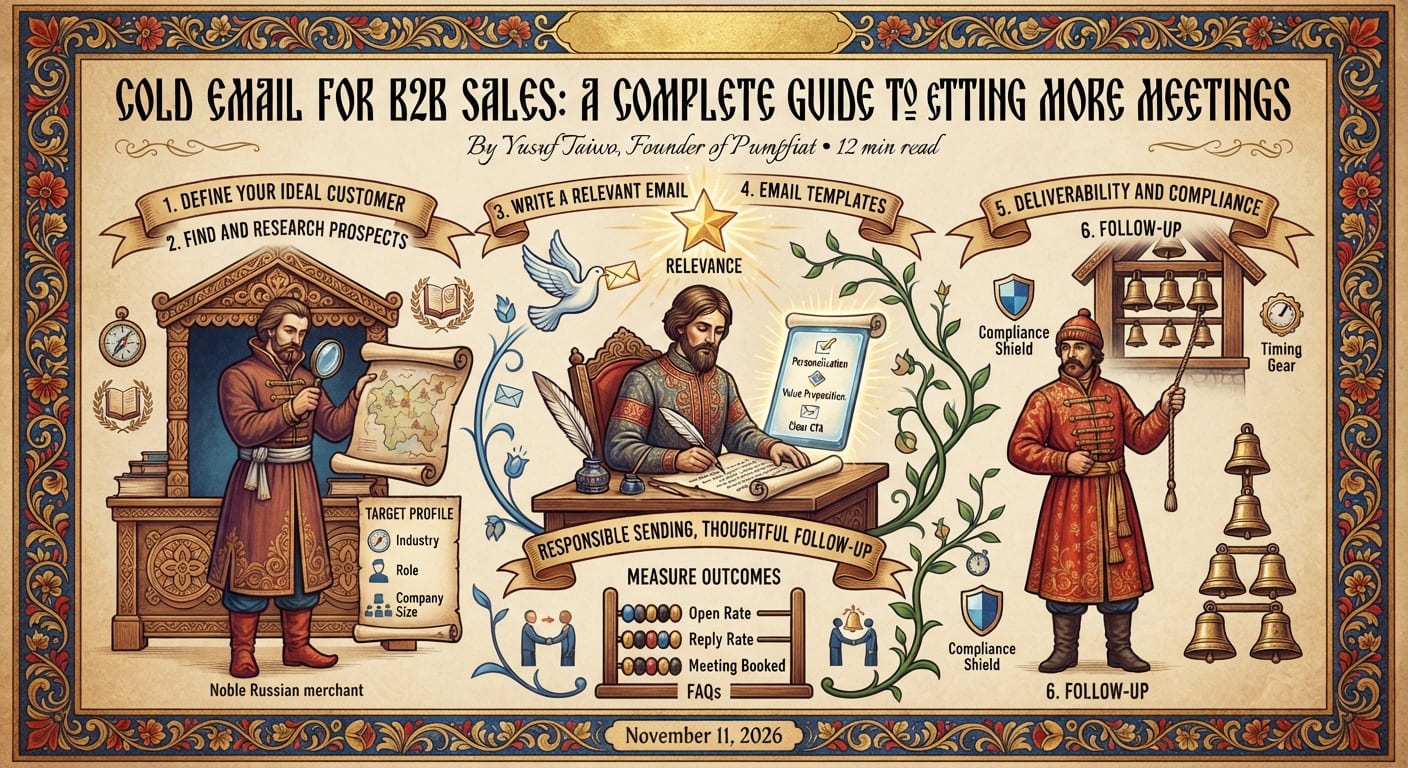
Your product may solve a real problem, but the right businesses cannot consider it if they have never heard of you. Cold email for B2B sales can introduce a relevant offer to a potential business customer—but only when prospect selection, message quality, sending practices, and follow-up are handled carefully.
Sending thousands of generic messages is not a sales strategy. A sound SDR process starts with a reason to contact a particular business and gives its recipient a clear, respectful choice about whether to continue the conversation.
1. What is cold email in B2B sales?
A cold email is a business email sent to someone with whom the sender has no prior relationship. In B2B sales development, its purpose may be to introduce a product or service, explore whether a need exists, or request a short conversation. It is not expected to close the entire sale in one message.
Think of it as one step in a sales process: identify an appropriate account, establish relevance, invite a response, record the result, and respect the recipient’s decision. Email is only one channel; it should fit the prospect’s role, the offer, and your organization’s approved outreach practices.
2. Define your ideal customer before prospecting
An Ideal Customer Profile (ICP) describes the organizations most likely to benefit from your offer. It helps SDRs spend research time on accounts that have a plausible business fit, rather than building a large list with no clear rationale.
Define attributes such as industry, company size, geography, business model, relevant technology, likely needs, purchasing context, and the decision-making roles involved. For example, a website redesign firm might focus on hospitality businesses where the booking journey is a meaningful part of customer acquisition. That example is not a universal ICP; use evidence from your own customers and product.
A practical ICP checklist
- Which businesses can use the offer and receive a specific benefit?
- What observable facts suggest a potential fit?
- Which role is most likely to understand or own the problem?
- Where can you reach that role through a legitimate business contact route?
- What would make an account a poor fit and therefore a suppression or exclusion?
3. Find the right companies and research them
Use company websites, professional networks, relevant business directories, and other appropriate sources to identify accounts and roles. Verify each prospect’s organization, role, and business contact details before outreach. A public listing is a starting point for research, not automatic permission for every use of personal data.
Research what the company sells, who it serves, how it presents its offer, what relevant business change or challenge is observable, and whether your service could realistically help. Keep a note of the source and the specific reason for contact so the SDR or manager can review the reasoning later.
Avoid manufacturing a problem. “Your website looks outdated” is a vague judgment. A more useful observation might describe a verifiable step in a mobile booking journey that could be simpler—without claiming to know the company’s conversion rate or internal priorities.
4. Write a clear, relevant B2B cold email
Keep the email focused on why you are contacting this person, what relevant observation you made, how your offer may help, and an easy next step. Personalization should be specific and true, not a first-name token wrapped around a generic pitch.
Five useful components
- Subject: Natural and accurate; do not imply an existing relationship that does not exist.
- Opening: Give a genuine reason for reaching out.
- Observation: Mention something relevant that you have actually verified.
- Offer: Explain in plain language how you help and why it may matter to this business.
- Call to action: Ask one low-friction question that allows the recipient to decline or redirect.
Prefer concise writing, a human sender identity, and a single clear point. Avoid unsupported performance claims, misleading urgency, excessive links, attachments the recipient did not request, or pressure tactics. Test clarity and relevance—not just open rates.
5. B2B cold email templates
Use these as structures, not copy-and-send scripts. Replace every bracket with accurate, researched information and remove any sentence that is not relevant.
Template: a specific business observation
Subject: A thought about [specific business process]
Hi [First Name],
I came across [Company] while researching [relevant market]. I noticed [specific, verifiable observation].
We help [type of business] with [relevant service/outcome]. If [related priority] is on your roadmap, I can share a couple of ideas tailored to what I saw.
Would that be useful, or is someone else better placed to discuss it?
Best,
[Name and company]
Template: B2B software or service
Subject: [Relevant process] at [Company]
Hi [First Name],
I’m reaching out because [accurate reason this role/company may be a fit]. We work with [customer type] on [plain-language use case].
Is improving [specific process] something your team is considering? If not, no problem—let me know and I’ll close the loop.
Best,
[Name and company]
Before sending, ask: would this message make sense to this recipient, is every claim supportable, and is the next step genuinely optional?
6. How many cold emails should an SDR send?
There is no universal daily or campaign volume that guarantees results. Appropriate volume depends on the audience, quality of research, sending infrastructure, domain reputation, relevant laws and platform policies, and the team’s capacity to handle replies and opt-outs.
Start with a controlled, well-targeted process. Review delivery issues, negative responses, qualified interest, and operational load before changing volume. Treat volume as a capacity measure—not the definition of SDR performance. For a broader measurement approach, see our guide to SDR KPIs and metrics.
7. Improve deliverability and protect sender reputation
Deliverability is affected by technical configuration, recipient data quality, sending practices, content, and recipient feedback. No single setting guarantees inbox placement. Work with the people responsible for your email systems and monitor provider guidance as requirements change.
- Configure and monitor SPF, DKIM, and DMARC for the sending domain.
- Use accurate business contact information and remove invalid or undeliverable addresses.
- Honor unsubscribes, objections, and suppression records across relevant systems.
- Keep sender identity and subject lines honest; avoid deceptive claims and unnecessary attachments.
- Monitor bounces and complaints; investigate problems rather than escalating volume.
- Provide a clear, usable way to stop further messages where required or appropriate.
Cold outreach rules vary with the sender, recipient, channel, data, and jurisdiction. Do not assume B2B email is exempt from privacy or marketing laws. Review the FTC’s CAN-SPAM guidance for the United States and the UK ICO guidance on B2B marketing; seek qualified advice for your circumstances and other jurisdictions.
8. Follow up without becoming a nuisance
A recipient may miss an initial message, but silence is not consent or proof of interest. A short sequence can be reasonable when permitted and when each follow-up remains relevant. Timing examples such as a few business days between messages are starting points only, not guaranteed best practice.
A useful follow-up can add one new, accurate detail, clarify the question, or politely close the loop. Stop when a person opts out, objects, or otherwise asks not to be contacted. Make sure that instruction is captured in the system used by the team.
Subject: Re: [Original subject]
Hi [First Name],
Following up once on my note about [relevant topic]. I thought [new and useful detail] might be relevant to [Company].
Would a brief conversation be useful? If this is not a priority, just let me know and I’ll close this out.
Best,
[Name]
9. Measure meaningful sales outcomes
Track enough of the funnel to diagnose what is happening: eligible prospects, messages sent, delivery and bounce issues, replies, positive replies, qualified meetings booked and held, accepted opportunities, and progression into pipeline. Define each metric so SDRs and sales leaders count it consistently.
A high reply rate can include negative replies; a booked meeting may not be held or qualified. Email open tracking can also be unreliable because of privacy protections and automated image loading. Use metrics as prompts for investigation and coaching, not as context-free targets.
Review a sample of actual prospect conversations alongside conversion data. Look for audience fit, message relevance, response quality, handoff quality, and whether opt-outs were respected. See our SDR metrics guide for a framework connecting activity to outcomes.
10. Common cold email mistakes
- Sending generic messages to people with no clear reason to care.
- Contacting the wrong role or failing to verify the business context.
- Inventing a personalized observation or making unsupported results claims.
- Using aggressive follow-ups or continuing after an opt-out or objection.
- Optimizing only for volume, opens, or meetings booked rather than qualified outcomes.
- Delegating outreach without checking data sourcing, message approval, opt-out handling, and ownership.
11. Manage outreach internally or with a partner?
An internal SDR team gives your business more direct control over prospect research, messaging, customer conversations, and coaching, while requiring recruitment, systems, and management. An external partner may provide capacity or operating expertise, but scope, data access, compliance responsibilities, and outcome definitions should be agreed in writing. Compare the trade-offs in our guide to in-house SDRs versus outsourced sales development.
Frequently asked questions
Is cold email effective for B2B sales?
It can be one way to introduce a relevant offer to potential business customers. Outcomes depend on targeting, the offer, message quality, deliverability, market conditions, and how the sales team handles responses.
How long should a B2B cold email be?
Use only enough copy to explain why you are reaching out, why it may matter to this recipient, and what simple next step you are proposing.
What is a good cold email reply rate?
Rates vary across audiences, industries, offers, and campaign methods. Avoid treating one internet benchmark as a universal target; distinguish positive, qualified replies from all replies.
Can I contact businesses internationally?
Cross-border outreach can involve different rules for electronic marketing and personal data. Check the rules that apply to your organization, recipients, data source, and communication channel before sending.

About the author
Yusuf Taiwo is the founder of Pumpfiat, a Notion Partner, automation expert, and AI systems builder. Read Yusuf’s profile and experience.
Build a more thoughtful outbound process
Explore Pumpfiat resources on prospect research, SDR hiring, and sales development operations.