
For many teams, outsourcing is seen as a cost advantage.
For the best teams, outsourcing is a talent strategy.
The difference comes down to one thing:
Are you simply renting labor, or are you building a high-performance extension of your organization?
Most companies treat outsourced talent as transactional — temporary, replaceable, interchangeable.
The result is predictable:
- high turnover
- knowledge loss
- inconsistent execution
- lack of strategic alignment
- no innovation
- slow ramp-up cycles
Meanwhile, the companies who win are the ones who treat outsourced teams the same way they treat internal teams — with systems for retention, training, and innovation.
At Pumpfiat, we support teams that run global operations, handle permission-first data, and scale outreach pipelines. We’ve seen exactly what separates the companies that outsource effectively from the ones who simply “spin plates.”
This article outlines the smart playbook for building outsourced teams who stay longer, perform better, and innovate with you — instead of just working for you.
1 Retention Is the First KPI of Smart Outsourcing
Most outsourcing fails not because talent is bad, but because the structure surrounding the talent is broken.
Turnover destroys:
- delivery consistency
- brand voice
- operational knowledge
- compliance alignment
- momentum
The smartest companies build retention intentionally.
A. Give Outsourced Talent Strategic Context
People perform better when they understand the mission, customer, and success metrics.
Pumpfiat clients who share “North Star” directives get better decisions, problem-solving, and loyalty.
B. Treat Outsourced Talent as Partners
Retention increases when talent is measured on outcomes, participates in calls, and is trusted with responsibility.
C. Create Stability Through Predictable Workflows
Unclear workflows create fatigue. Smart teams build SOPs, templates, and volume predictability.
Pumpfiat’s automation systems eliminate friction that makes talent quit.
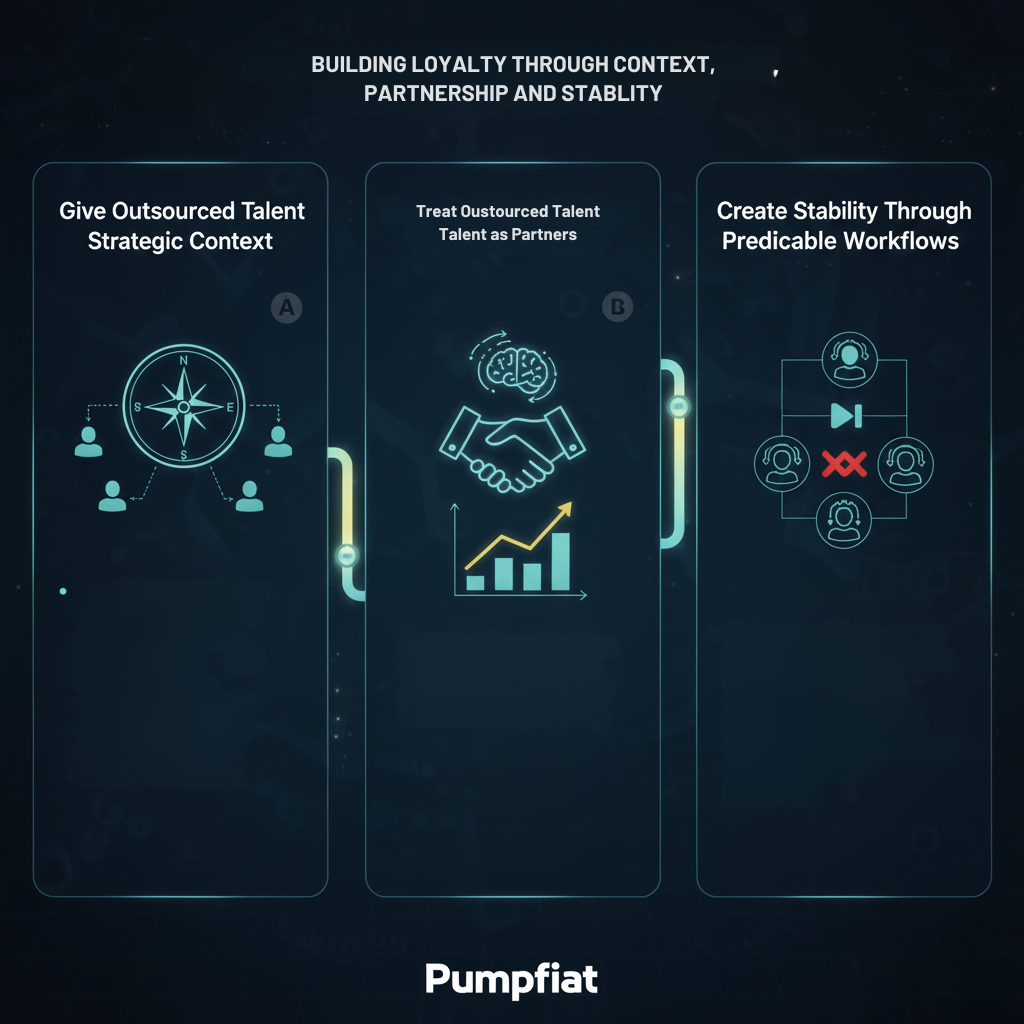
Building loyalty through context, partnership, and stability
2 Training Is Not Optional — It’s The Lever That Multiplies Output
Outsourced talent does not get better on their own.
Not because they can’t — but because teams rarely invest in training them.
A. Build a Real Onboarding Pipeline
High-growth teams develop role-based docs, videos, examples, and tool guides.
Pumpfiat builds Notion-based systems that reduce training time by 70%.
B. Train With Real Scenarios
The best training includes real customer interactions, data, objections, and issues.
C. Continuous Training > One-Time
Build permanent loops: monthly upskilling, weekly debriefs, tool refreshers.
This mirrors Pumpfiat’s internal culture of continuous learning.
3 Innovation Doesn’t Happen By Accident — It Must Be Engineered
Companies often assume outsourced teams cannot innovate.
But this is only true when the environment suppresses innovation.
A. Give Teams Permission to Improve
Encourage suggestions on processes, workflows, automation, and customer journeys.
Pumpfiat clients gain efficiencies by letting talent “upgrade” systems.
B. Build Automation & AI Into Workflows
Empower teams with AI writing, QA automation, inbox tools, and sentiment analysis.
C. Create Cross-Team Idea Exchanges
Host brainstorming, shared dashboards, and competitive intelligence briefings.
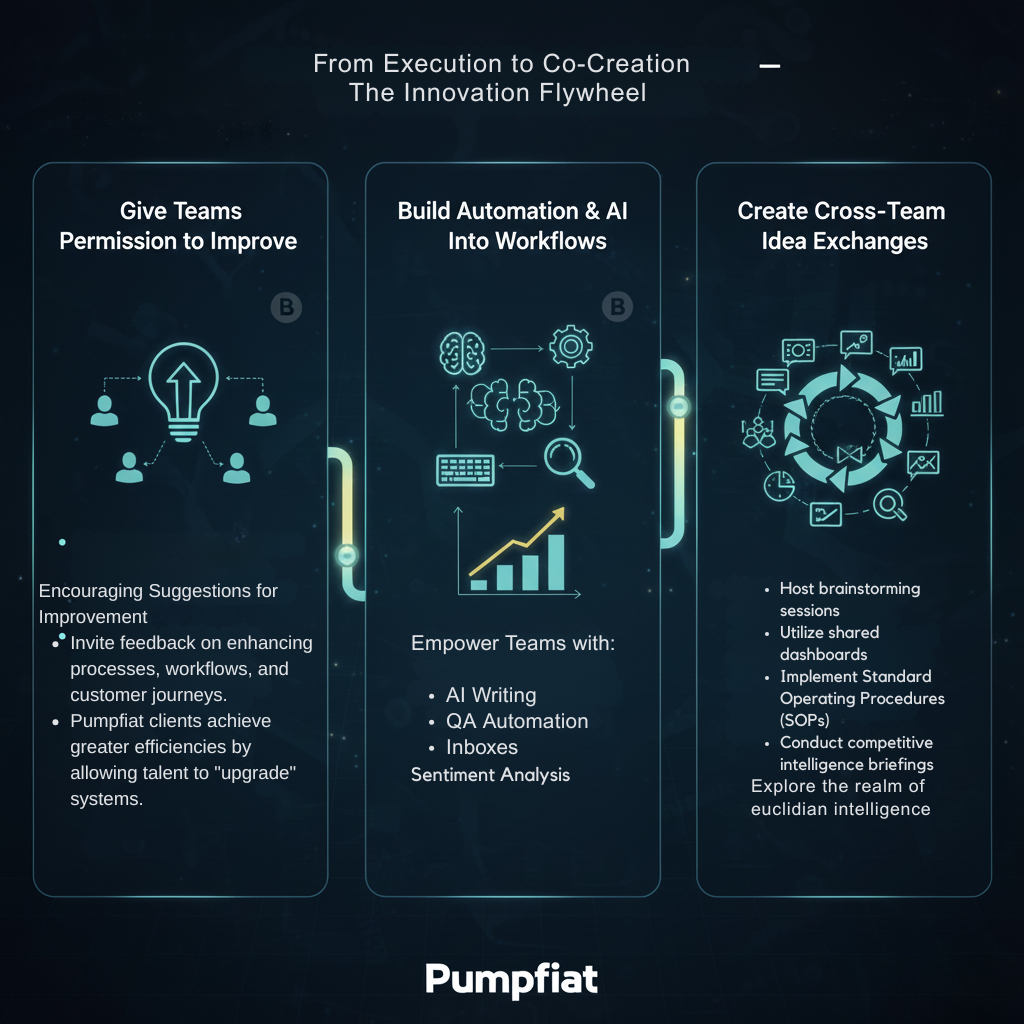
From execution to co-creation — the innovation flywheel
4 The Smart Outsourcing Framework: The Pumpfiat Standard
Below is the distilled blueprint used by high-growth brands scaling responsibly and efficiently.
Retention Framework
- Treat outsourced talent as long-term partners
- Build clarity into every workflow
- Provide mission context
- Maintain predictable responsibilities
- Give recognition and professional respect
Training Framework
- Concrete onboarding
- Real-world scenario practice
- Continuous upskilling cycles
- SOP Libraries + automation guides
- Role-based KPIs
Innovation Framework
- Encourage idea contribution
- Equip teams with AI and automation
- Host cross-functional exchanges
- Reward process improvements
- Build dashboards showing their impact
5 Why This Matters More in 2025 than Ever Before
Today’s organizations are distributed, outsourced, AI-powered, and global.
This means:
- talent is more available
- expectations are higher
- competition is intense
- the bar for execution is higher
- the margin for inefficiency is smaller
Smart outsourcing isn’t about reducing cost —
it’s about creating high-performance, scalable talent infrastructure that compounds.
Companies who master this create:
- higher consistency
- lower turnover
- stronger productivity
- faster onboarding
- continuous improvement
- competitive advantage
- better customer outcomes
This is exactly how Pumpfiat builds its own internal and client-facing systems.
Conclusion
Outsourcing only becomes low-quality when the system around it is low-quality.
When executed properly, outsourcing becomes:
- a talent strategy
- an innovation engine
- a retention multiplier
- a competitive advantage
- and a force multiplier for growth
Retention + training + innovation create outsourced teams that perform as well as — or better than — internal teams.
Companies who embrace this are the ones who scale fast without breaking systems, burning talent, or compromising quality.