
When most companies think “data compliance,” they think GDPR.
It’s the landmark regulation that redefined digital privacy and shaped how modern organizations collect, process, and store customer data.
But here’s the shift many teams still haven’t internalized:
GDPR is no longer the standard — it’s just the starting point.
Compliance today is global, multi-layered, sector-specific, and increasingly enforced.
For companies outsourcing data operations, enrichment, support, or outreach, this complexity is amplified.
One misalignment between your vendor’s practices and your regional obligations can trigger fines, deliverability issues, legal exposure, and loss of customer trust.
This article breaks down the new global compliance landscape, explains the risks for outsourced teams, and provides a playbook for evaluating vendors in 2025 and beyond — aligned with how Pumpfiat operates as a permission-first, audit-grade data provider.
1 GDPR Was Phase One — Now the World Has Its Own Rules
GDPR created global ripple effects, but it’s only one piece of the regulatory puzzle.
North America
- CCPA / CPRA (California)
- Colorado Privacy Act
- Virginia Consumer Data Protection Act
- FTC Section 5 rules
- Email deliverability enforcement by Google & Yahoo (2024 update)
Most brands are more at risk of violating CPRA or deliverability standards than GDPR.
Europe (Beyond GDPR)
- Digital Markets Act (DMA)
- Digital Services Act (DSA)
- ePrivacy Directive updates
Latin America
- LGPD (Brazil)
- Habeas Data (Colombia)
- Ley de Protección de Datos Personales (Argentina)
Asia-Pacific & Beyond
- PDPA (Singapore)
- PIPA (South Korea)
- Privacy Act (Australia)
- China PIPL — extremely strict data-export controls
- POPIA (South Africa)
- Nigeria NDPR
- Saudi Data Protection Law (PDPL)
In short:
Global compliance is no longer harmonized. It is fragmented — and vendors must operate with geographic intelligence.
2 Why Outsourcing Makes Compliance Risk Multiply
Outsourcing creates operational leverage — but it also creates blind spots.
Without a strong compliance framework, outsourcing becomes a liability in five ways:
Data Origin Becomes Untraceable
If your vendor cannot prove where data came from, how consent was obtained, and what rights were granted — you are exposed.
Consent Standards Differ by Region
A “valid” opt-in in Europe may be invalid in the US or APAC.
Data Transfers Cross Jurisdictions
Your vendor may be processing EU data on US infrastructure — without model clauses.
Deliverability Regulations Count as Compliance
Google and Yahoo now enforce authentication, complaint rates, opt-out placement, and domain trust.
Accountability Flows Upward
Regulators hold the brand responsible, not the vendor.
This is why the next generation of compliant vendors — including Pumpfiat — operate with global-first compliance architecture, not GDPR-only checkboxes.
3 The Global Compliance Playbook for Outsourcing (The Pumpfiat Model)
Below is a practical framework based on how Pumpfiat executes compliance across markets.
This is the checklist high-growth teams use when assessing outsourced data partners.
A. Data Sourcing Transparency
Every vendor must disclose:
- Data origin categories (publisher, partner, first-party source, API, opt-in form)
- Consent mechanism (double opt-in, express, contextual, contractual)
- Timestamped logs tied to each profile
- Jurisdiction of acquisition (EU, US, APAC)
- Purpose limitation (what the user agreed to receive)
Why it matters: A dataset is only as compliant as the rights attached to it.
Pumpfiat’s approach: Every record is tied to a permission event. No scraped data. No inferred identities.
B. Cross-Border Data Transfer Controls
Ask every vendor:
- Where is data stored?
- Where is it processed?
- Are Standard Contractual Clauses (SCCs) in place?
- Are regional routing rules applied?
- Is the vendor compliant with PIPL export requirements (China)?
Pumpfiat’s approach: We operate a geo-aligned processing model, routing sensitive data to infrastructure in its legal region.
C. Deliverability & Messaging Compliance
Outsourced outreach often fails because the vendor violates:
- Google/Yahoo 2024 authentication rules
- complaint threshold limits
- opt-out visibility requirements
- sending-domain reputation minimums
Pumpfiat’s approach: warm-up orchestration, volume throttling, domain aging, AI spam-model checks, compliant permission segmentation.
D. Vendor Security Certifications
A compliant vendor must maintain:
- SOC 2 or SOC readiness
- ISO 27001 alignment
- HIPAA-level storage if healthcare signals exist
- MFA/SSO access control
- Encryption in transit + at rest
- Zero-trust segmentation
Pumpfiat’s approach: Security badges are guarantees — not decorative.
E. Data Subject Rights Handling
Any vendor handling private data must support:
- DSAR processing
- erasure requests
- correction workflows
- export rights
- opt-out enforcement
- retention limits
Pumpfiat’s approach: Rights requests propagate across every pipeline and historical record.
F. Usage Controls & Ethical Enforcement
That means:
- ethical-use policies,
- anti-spam agreements,
- purpose-driven use rights,
- data minimization clauses.
Pumpfiat’s approach: We require clients to agree to an Anti-Abuse & Ethical Use Policy.
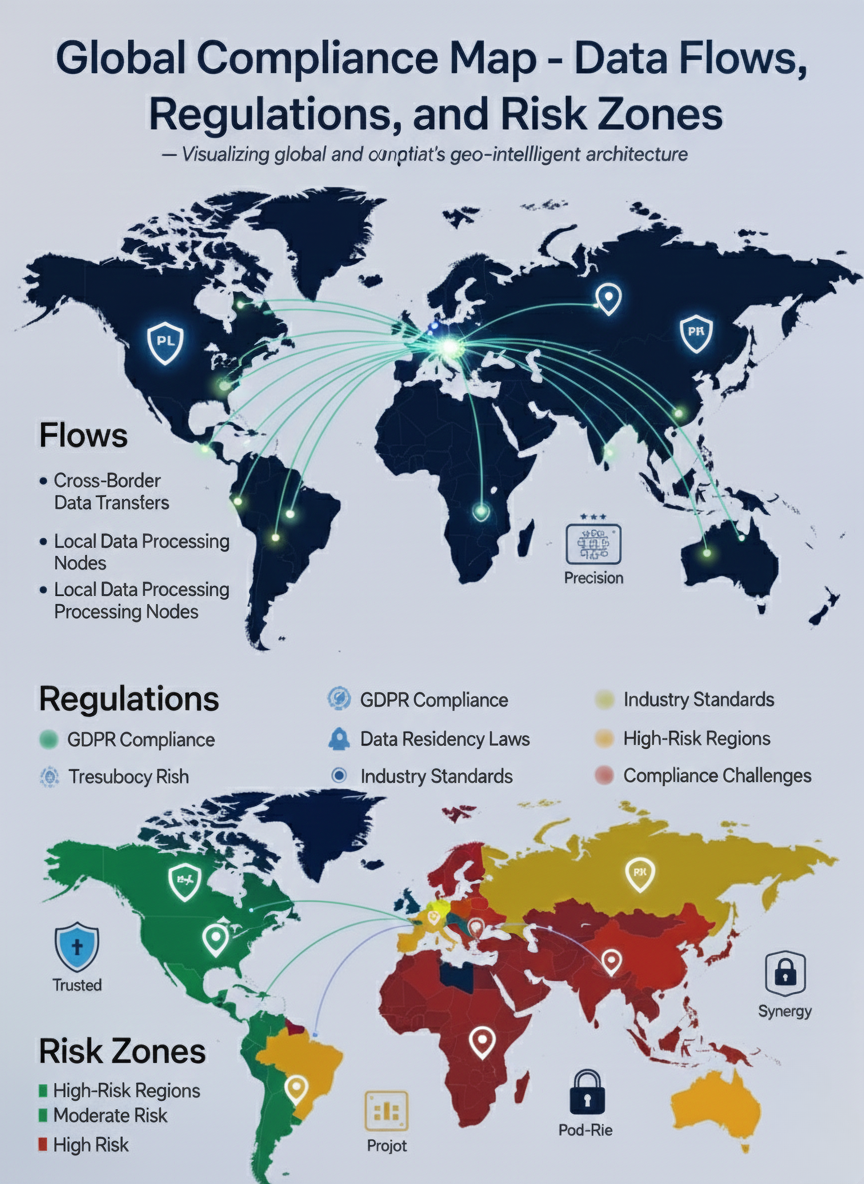
Visualizing global data flows and compliance zones — Pumpfiat’s geo-intelligent architecture
4 A New Compliance Reality: "Global by Default"
Compliance used to be reactive.
Now it must be designed into your data supply chain.
In 2025 and beyond, the winning organizations will operate with:
- jurisdiction-aware data routing
- permission-first enrichment
- transparent sourcing
- end-to-end audit trails
- AI-powered deliverability protection
- security certification as a baseline
This is exactly the architecture Pumpfiat delivers to clients.
Outsourcing isn’t risky when the vendor treats compliance as an engineering discipline — not a checkbox exercise.
5 The Bottom Line
GDPR was the wake-up call.
The world that followed is the real challenge.
Brands can’t afford to work with vendors who operate in a single-regulation mindset.
They need partners built for:
- global data routes,
- multi-jurisdiction compliance,
- strict procurement standards,
- and audit-ready transparency.
This is the standard Pumpfiat was built on.
If you want data, enrichment, or outreach infrastructure that scales without regulatory risk, you need a global compliance approach — not a local one.
And Pumpfiat brings exactly that.