
Consumer goods is one of the fastest-evolving industries in 2025.
Margins are tighter. Acquisition costs are rising. Customer expectations are exponential.
And in the center of that pressure is generative AI — rewriting how brands create products, deliver experiences, automate operations, and build loyalty at scale.
But here’s the truth the industry doesn’t like to say out loud:
Generative AI doesn’t create excellence by itself —
It amplifies the quality of your data, compliance, segmentation, and identity foundation.
This is where Pumpfiat operates.
Not in building chatbots — but in building the data layer that makes AI worth anything.
Let’s break down how generative AI is transforming consumer goods when paired with permission-based, enriched, compliant data ecosystems.
1 Generative AI Is Reshaping Product Development — But Only With High-Fidelity Data
Consumer brands used to rely on:
- slow surveys
- lagging indicators
- manual trend reports
- guesswork, intuition, and best practices
Now generative AI can compress:
- market analysis
- competitor scanning
- trend prediction
- aesthetic exploration
- consumer sentiment mapping
into a few seconds.
But the accuracy depends on the input signals.
When brands feed AI:
- ❌ Unverified demographic data
- ❌ Noisy behavioral signals
- ❌ Scraped datasets with no consent trail
- ❌ Incomplete or inconsistent buyer profiles
Result: generic insights, wrong interpretations, false positives, products for “imaginary customers”
When brands feed AI Pumpfiat-grade data:
- Verified identity
- Permission-based profiles
- Enrichment attributes tied to real intent
- Behavioral clarity
- Clean demographic + firmographic signals
AI becomes a product co-designer, not a guessing machine.
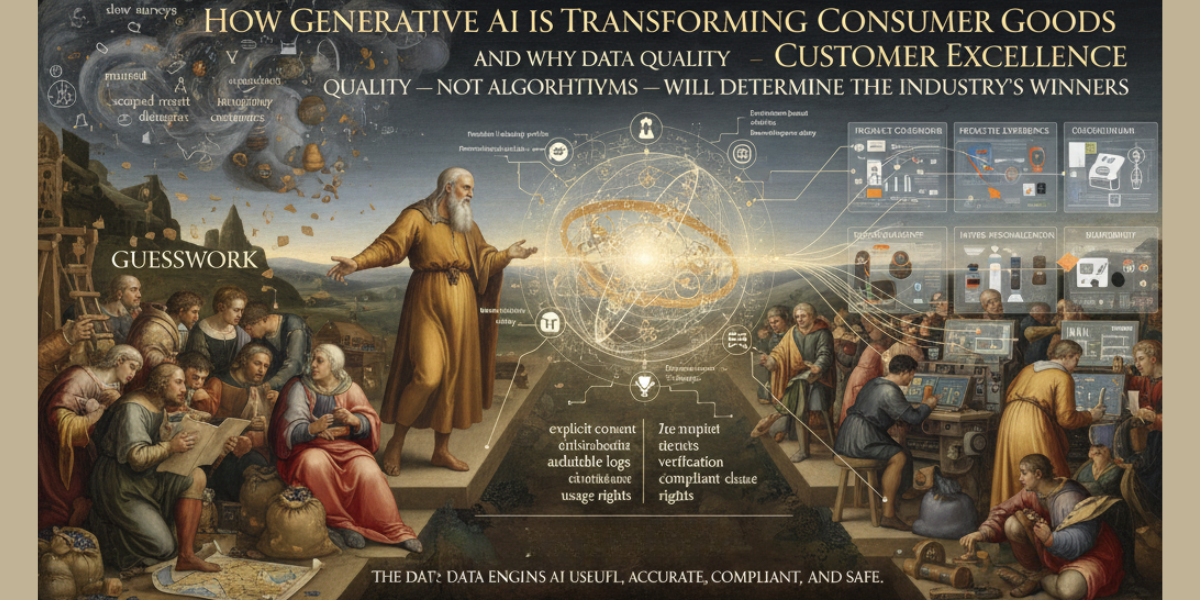
AI-powered product ideation grounded in real, permissioned consumer signals
2 Generative AI Is Rewriting Customer Excellence
The consumer goods industry is shifting from transactional experience to predictive experience.
Generative AI can now:
- anticipate customer questions before they’re asked
- auto-personalize support responses
- predict dissatisfaction early
- detect churn signals
- design proactive retention flows
- create personalized instructions, recommendations, and education
But once again — accuracy depends entirely on your dataset.
AI cannot anticipate anything if it doesn’t know who the customer is, what they care about, or what’s happening in their lifecycle.
This is why consumer goods companies are investing in permission-first, identity-resolved datasets more than ever.
Pumpfiat provides this backbone.
3 Hyper-Personalization Is No Longer a “Nice to Have” — It’s Expected
Generative AI allows brands to deliver:
- dynamic product bundles
- individualized upsells
- personalized care guides
- behavior-based promotions
- adaptive post-purchase flows
- custom content based on lifestyle, region, and demographic
But personalization is only legal if it’s permissioned.
Today’s regulatory frameworks (GDPR, CCPA, CPRA, DMA, LGPD) treat:
- pseudonymization,
- identity tracing,
- and enrichment workflows
as high-risk activities without proper consent trails.
This is where Pumpfiat becomes a safety net.
We don’t generate synthetic identities.
We don’t scrape.
We don’t “infer” demographics behind a user’s back.
We build personalization on a foundation of:
- explicit consent,
- auditable logs,
- identity verification,
- transparent enrichment,
- and compliant usage rights.
This lets brands use generative AI without risking fines, deliverability penalties, or trust erosion.
4 AI-Powered Consumer Intelligence Is Becoming a Growth Engine
Generative AI can map:
- regional preferences
- seasonality behavior
- consumption cycles
- product affinity
- retention cohorts
- micro-trends at the SKU level
But the machine only understands patterns when fed structured, high-quality signals.
Pumpfiat’s enrichment layer adds attributes that help AI models identify:
- RFM segments
- price sensitivity
- product-category match
- subscription intent
- buying friction indicators
- sentiment clusters
- predictive LTV
This gives consumer goods companies a competitive edge:
You know what the customer wants before they know they want it.
5 Generative AI Is Transforming Communications, But Deliverability Still Rules
Most brands assume AI-generated emails, SMS, and push notifications will automatically increase conversions.
But generative AI can also:
- over-send
- create repetitive tones
- trigger spam filters
- violate compliance frameworks
- generate risky language
- degrade sender reputation
This is why deliverability-first infrastructure is essential.
Pumpfiat prevents AI from accidentally doing harm:
- AI-safe language patterns
- Spam-trigger detection
- Message throttling
- Domain/IP protection
- Consent-based targeting
- Verified recipient datasets
Generative AI improves communication —
Pumpfiat ensures it lands.
6 The Hybrid Future: AI + Human Teams Supported by Permission-Based Data
Across the consumer goods landscape, the winning model isn’t AI replacing teams.
It’s AI augmenting human capabilities, powered by clean, auditable data.
AI Handles
- drafting
- analysis
- dynamic personalization
- recommendation logic
- content generation
- predictive modeling
Humans Handle
- strategy
- creativity at the edges
- brand tone refinement
- high-stakes communication
- compliance decisions
- final QA
The result is customer excellence that feels:
- fast,
- accurate,
- deeply personalized,
- and human-safe.
7 Where Pumpfiat Fits Into This Transformation
Pumpfiat isn’t an AI tool.
It is the data engine that makes AI useful, accurate, compliant, and safe.
Pumpfiat provides consumer goods brands with:
- Permission-based prospect data
- Multi-layer enrichment
- Identity resolution
- Segmentation engineered for AI
- Compliance frameworks (SOC, ISO, GDPR-ready)
- Deliverability-optimized communication workflows
- Predictive data signals for hyper-personalization
- Secure, audit-ready consent logs
We don’t sell “leads.”
We build the data infrastructure that powers the next generation of AI-driven consumer experiences.
8 The Bottom Line: AI Will Not Replace Brands — But It Will Replace Brands Without Data Discipline
Consumer goods leaders are waking up to a simple truth:
AI is not the competitive advantage.
The competitive advantage is the quality of the data feeding the AI.
Brands that combine:
- permissioned identity
- structured enrichment
- predictive segmentation
- deliverability excellence
- and compliant communication
…will dominate the next era of consumer goods.
And Pumpfiat exists to make that transformation possible.